.
I have been "just listening" to all the classes I've signed up for so far this year.
How Things Work 1 ended a couple of months ago. I feel bad about this one. I was so thrown for a loop at learning that A) pounds and kilos do not measure the same thing, along with B) no one ever told me!, that I had to just stop dead and work on taking it in. By the time I'd revised my world view sufficiently to proceed, I was so far behind that I never caught up. I surely hope he offers this class again soon. I would like to give it another shot. I believe I can still listen to the lectures. I should find out, and do that, if I can......
The Music of the Beatles is over (will be offered again in July 2014). I listened to all the lectures, and listened to a significant amount of music related to the class on youtube.
Marine Megafauna: An Introduction to Marine Science and Conservation is over. I listened to all the lectures but the last week. That was when we got to the heavy-duty "conservation" part of the class, and I really don't think I want to listen to "Whales and the Age of Sail".............. I have a general idea of the atrocities we perpetrated on whales, and I really don't want to know the details...........
Archaeology's Dirty Little Secrets ended last week. I took Secrets last summer, and loved it, so I took it again to enjoy the new bits and savor the old. No notes/exercises/exams for me, this time around.
Roman Architecture ends this week (I have one lecture worth of videos to watch and take notes on). I've listened to all the lectures, and have taken reasonable notes, for my own possible future reference (should I go somewhere where the works she described still exist), but have not written any papers nor taken any quizzes/exams.
Music's Big Bang: The Genesis of Rock 'n' Roll ends next week (and I'm caught up for this week). Just listening. No notes, no homework, no quizzes/exams. Greater familiarity with some of the pre-rock music he is talking about has not helped me to enjoy it more. Some of those styles just do not float my boat. Unlike the other rock classes I've taken, he has played us a significant amount of music. No whole pieces, but healthy chunks of many pieces. I haven't felt compelled to search out more of it on youtube.
It's good that my plate is almost cleared -- in addition to Maps and the Geospatial Revolution and Epigenetic Control of Gene Expression, I'm signed up for Understanding the Brain: The Neurobiology of Everyday Life. (all of these start next week)
Our neuro bio teacher is totally geeked about teaching the class. She has a blog and a twitter feed....... Gotta love her level of enthusiasm, and her conviction that the world would be a better place if everyone knew more about brains.
I'm not making decisions ahead of time about whether I will or won't do more than "just listen" in neuro bio or epigenetics. I will do the labs for maps, because I learned so much from them last time, but I don't know if I'll take any quizzes/exams........
And -- I'm working at NOT looking at what other offerings might be available just now........... Which is hard, because you can't count on these classes being offered in the future, and what if I missed the one offering of a totally dynamite class???
.
Showing posts with label Archaeology's Dirty Little Secrets. Show all posts
Showing posts with label Archaeology's Dirty Little Secrets. Show all posts
Thursday, April 24, 2014


Wednesday, January 29, 2014
Arcchaeology's Dirty Little Secrets
.
This fabulous class, which I took last summer, is being offered again soon -- Feb. 24.
Archaeology's Dirty Little Secrets comes with my highest recommendation. I expect I'm going to be taking it again, just because it was so interesting and well-taught...........
If you have any interest in archaeology, I urge you to sit in on the lectures. No one cares if you do only that (and skip the assignments and quizzes).......... But you may find you are intrigued by the assignments, as I was, and choose to write something in cuneiform, say.
.
This fabulous class, which I took last summer, is being offered again soon -- Feb. 24.
Archaeology's Dirty Little Secrets comes with my highest recommendation. I expect I'm going to be taking it again, just because it was so interesting and well-taught...........
If you have any interest in archaeology, I urge you to sit in on the lectures. No one cares if you do only that (and skip the assignments and quizzes).......... But you may find you are intrigued by the assignments, as I was, and choose to write something in cuneiform, say.
.
Friday, November 01, 2013
UPDATED 11/2/13 -- This week in Dino class.....
...they are talking about stratigraphy and the
principal of superposition (older stuff on the bottom, newer stuff on
top, generally speaking). We learned about both of those concepts in archaeology (not a surprise), but while ideas are the same, the reality in the two concepts is quite different. The
entire archaeological record is in the last 200,000 years. The dinos
all lived more than 60 million years ago, and what can happen to the
rocks (let alone the continents and their positions!) in that amount of
time makes the stratigraphy much more ... interesting.
Fossils are found in sedimentary rock. Layers of sediment are laid down (in river channels, perhaps), and, over (LOTS OF) time, they become rock. Later still, a volcano may erupt up through the layers, or the layers may be near new mountain ranges which tip the older formations (or "crunch and fold" them). Tipped, crunched, and folded formations may have their top surfaces eroded away, and new layers may be laid on top.................
(At least the geography has stayed put [relatively speaking], in the archaeological context!)
Given that fossilization only takes place in wet environments (things have to be buried rather quickly if they are going to fossilize), which doesn't happen in desserts at all, and doesn't happen in forests or prairies, either, really, and given that carcases are scavenged, and/or tumbled along with the current in a river bed before they ever might be fossilized, and given that we don't find fossils until they are exposed on the surface of the earth, generally speaking, and that they will erode away to nothing once exposed.....
Throw in all of that geological manipulation of the rocky structure of the surface of the planet over the millions of years..........
Given all that, it's amazing that we know anything about dinos at all, I think.
And yet we do, and we're learning more all the time. Cool...............
Dino class is being taught from the University of Alberta. I've thought about taking the trans-Canada train. Yesterday I wondered how close the trans-Canada train goes to Dinosaur Provincial Park in Alberta, and I spent some time looking at maps. (The answer is -- Edmonton, where U of Alberta is, is on the trans-Canada route, and Dino Park is about 4 hours from Edmonton by car.)
I bet Coursera didn't think about enhanced tourism as one of the benefits of their offerings, but I bet it is happening...........
UPDATE, 11/2/13 -- Victoria, who left a comment here (how cool is that???), is one of our teachers in Dino 101! Her blog is here, with lots of info about paleontological doings in Edmonton and surrounds. Thanks for the visit here, Victoria, and for commenting. I would LOVE to visit the lab!!! :-)
ps, Victoria -- if I make any mistakes in anything I say about Dino class here, I hope you will correct me!
.
Fossils are found in sedimentary rock. Layers of sediment are laid down (in river channels, perhaps), and, over (LOTS OF) time, they become rock. Later still, a volcano may erupt up through the layers, or the layers may be near new mountain ranges which tip the older formations (or "crunch and fold" them). Tipped, crunched, and folded formations may have their top surfaces eroded away, and new layers may be laid on top.................
(At least the geography has stayed put [relatively speaking], in the archaeological context!)
Given that fossilization only takes place in wet environments (things have to be buried rather quickly if they are going to fossilize), which doesn't happen in desserts at all, and doesn't happen in forests or prairies, either, really, and given that carcases are scavenged, and/or tumbled along with the current in a river bed before they ever might be fossilized, and given that we don't find fossils until they are exposed on the surface of the earth, generally speaking, and that they will erode away to nothing once exposed.....
Throw in all of that geological manipulation of the rocky structure of the surface of the planet over the millions of years..........
Given all that, it's amazing that we know anything about dinos at all, I think.
And yet we do, and we're learning more all the time. Cool...............
Dino class is being taught from the University of Alberta. I've thought about taking the trans-Canada train. Yesterday I wondered how close the trans-Canada train goes to Dinosaur Provincial Park in Alberta, and I spent some time looking at maps. (The answer is -- Edmonton, where U of Alberta is, is on the trans-Canada route, and Dino Park is about 4 hours from Edmonton by car.)
I bet Coursera didn't think about enhanced tourism as one of the benefits of their offerings, but I bet it is happening...........
UPDATE, 11/2/13 -- Victoria, who left a comment here (how cool is that???), is one of our teachers in Dino 101! Her blog is here, with lots of info about paleontological doings in Edmonton and surrounds. Thanks for the visit here, Victoria, and for commenting. I would LOVE to visit the lab!!! :-)
ps, Victoria -- if I make any mistakes in anything I say about Dino class here, I hope you will correct me!
.
Sunday, September 08, 2013
clade
.
I'm not only learning a lot of anatomy in Dinos 101: Dinosaur Paleobiology, I'm learning a lot of vocabulary, too.
We learned that one group of ornith(bird)ischian(hipped) dinos includes hadrosaurs and iguanodons. I went to look up whether that is "iguanodon" or "iguanodonT"
I discovered that "Iguanodontia is a clade of herbivorous dinosaurs that lived from the Middle Jurassic to Late Cretaceous. Some members include Camptosaurus, Callovosaurus, Iguanodon, Tenontosaurus, and the hadrosaurids or 'duck-billed dinosaurs'."
Okayyyyyyyyyyyyyyyyy..... We know from the lecture that the group includes hadrosaurs and iguanodons (no T, apparently), but ... what's a "clade"????
"A clade (from Ancient Greek κλάδος, klados, "branch") or monophylum (see monophyletic) is a group consisting of an ancestor and all its descendants, a single "branch" on the "tree of life".[1]"
(Both quotes from Wikipedia.).
I am learning stuff right and left! That makes me happy................
--------------------------------------------------------
In Archaeology's Dirty Little Secrets we had a poetry corner in the fora. (I contributed a couple of limericks and a haiku. I should probably publish them here, one day....) There are a lot of people from DLS in dino class, and today someone opened a poetry corner in the dino fora. I have contributed a limerick:
What I knew about breathing was lacking.
In Biology I must have been slacking.
I was clear that birds flew,
but ... air sacs? Who knew?
I'll catch up, but I'd better get cracking!
Now I'm thinking I have to write something that includes the word "clade"............
Because it's cool, and it's new (to me), and it rhymes with a lot of words!
.
I'm not only learning a lot of anatomy in Dinos 101: Dinosaur Paleobiology, I'm learning a lot of vocabulary, too.
We learned that one group of ornith(bird)ischian(hipped) dinos includes hadrosaurs and iguanodons. I went to look up whether that is "iguanodon" or "iguanodonT"
I discovered that "Iguanodontia is a clade of herbivorous dinosaurs that lived from the Middle Jurassic to Late Cretaceous. Some members include Camptosaurus, Callovosaurus, Iguanodon, Tenontosaurus, and the hadrosaurids or 'duck-billed dinosaurs'."
Okayyyyyyyyyyyyyyyyy..... We know from the lecture that the group includes hadrosaurs and iguanodons (no T, apparently), but ... what's a "clade"????
"A clade (from Ancient Greek κλάδος, klados, "branch") or monophylum (see monophyletic) is a group consisting of an ancestor and all its descendants, a single "branch" on the "tree of life".[1]"
(Both quotes from Wikipedia.).
I am learning stuff right and left! That makes me happy................
--------------------------------------------------------
In Archaeology's Dirty Little Secrets we had a poetry corner in the fora. (I contributed a couple of limericks and a haiku. I should probably publish them here, one day....) There are a lot of people from DLS in dino class, and today someone opened a poetry corner in the dino fora. I have contributed a limerick:
What I knew about breathing was lacking.
In Biology I must have been slacking.
I was clear that birds flew,
but ... air sacs? Who knew?
I'll catch up, but I'd better get cracking!
Now I'm thinking I have to write something that includes the word "clade"............
Because it's cool, and it's new (to me), and it rhymes with a lot of words!
.
Friday, August 30, 2013
the most difficult language
.
Here's an interesting article from The Economist about how difficult it is to master different languages.
The article makes the argument that, compared to really difficult-to-master languages, English isn't, very.
(I'm weirded out that there's no byline. I wonder who wrote the article! I would like to give that person credit!)
Reading the article -- 350 genders? Really? Yikes! -- made me think of my exercise in writing cuneiform for Archaeology's Dirty Little Secrets.
Do you remember what I learned about writing numbers in Akkadian? This is from Wikipedia:
The numerals 1 and 2 as well as 21–29, 31–39, 41–49 correspond with the counted in the grammatical gender, while the numerals 3–20, 30, 40 and 50 show gender polarity, i.e. if the counted noun is masculine, the numeral would be feminine and vice versa. This polarity is typical of the Semitic languages and appears also in classical Arabic for example. The numerals 60, 100 and 1000 don't change according to the gender of the counted noun. Counted nouns more than two appear in the plural form. However, body parts which occur in pairs appear in the dual form in Akkadian. e.g. šepum (foot) becomes šepān (two feet).
I suppose that 350 genders, and all of the other sorts of complexity that can be encountered in languages, add richness and interest. Maybe our ways of saying things are trivial and boring in comparison?
I came across a link to the article in an email from A Word A Day.
.
Here's an interesting article from The Economist about how difficult it is to master different languages.
The article makes the argument that, compared to really difficult-to-master languages, English isn't, very.
(I'm weirded out that there's no byline. I wonder who wrote the article! I would like to give that person credit!)
Reading the article -- 350 genders? Really? Yikes! -- made me think of my exercise in writing cuneiform for Archaeology's Dirty Little Secrets.
Do you remember what I learned about writing numbers in Akkadian? This is from Wikipedia:
The numerals 1 and 2 as well as 21–29, 31–39, 41–49 correspond with the counted in the grammatical gender, while the numerals 3–20, 30, 40 and 50 show gender polarity, i.e. if the counted noun is masculine, the numeral would be feminine and vice versa. This polarity is typical of the Semitic languages and appears also in classical Arabic for example. The numerals 60, 100 and 1000 don't change according to the gender of the counted noun. Counted nouns more than two appear in the plural form. However, body parts which occur in pairs appear in the dual form in Akkadian. e.g. šepum (foot) becomes šepān (two feet).
I suppose that 350 genders, and all of the other sorts of complexity that can be encountered in languages, add richness and interest. Maybe our ways of saying things are trivial and boring in comparison?
I came across a link to the article in an email from A Word A Day.
.
Friday, August 23, 2013
Come, Tell Me How You Live
.
There's thread in the discussion forum in Archaeology's Dirty Little Secrets on fiction with an archaeological component. I've put lots of books on hold at the library.........
Come, Tell Me How You Live is not fiction. Agatha Christie's second husband, Max Mallowan, was an archaeologist. Agatha met him at Ur, where Puabi (whose treasures I saw in Philadelphia at the Penn Museum last year) was found.
Max dug in Iraq, and in Syria, and Agatha went along and was indispensible. She became a ceramics specialist, and did a lot of photography (artifacts, and dig sites, and....), including developing the film and printing photographs.
Come, Tell Me How You Live is a memoir. There are moments of beautiful description of the landscape and the atmosphere. But mostly the book consists of anecdotes describing how difficult life was. Dirt, disease, government bureaucracy, mice, bats, culture clash (not only between Europeans and Arabs, but between Arabs and Kurds, Arabs and Armenians, and, of course, clashes between Arabs and Arabs....).
While most of it sounded seriously awful to me, nearly always when she describes how she felt about life on a dig in the middle east between the wars, she found it deeply satisfying.
Guarded recommendation. I'd rather have heard more about the aspects of that life she loved, and less about the difficulties. Especially since, over all, she seems to have really loved it. (And, for the record, though they were at digs for almost the whole book, there is vanishingly little archaeology in the book. The "managing a dig" parts appear, but the "what did we find and what did we make of it" -- alas, no.)

.
There's thread in the discussion forum in Archaeology's Dirty Little Secrets on fiction with an archaeological component. I've put lots of books on hold at the library.........
Come, Tell Me How You Live is not fiction. Agatha Christie's second husband, Max Mallowan, was an archaeologist. Agatha met him at Ur, where Puabi (whose treasures I saw in Philadelphia at the Penn Museum last year) was found.
Max dug in Iraq, and in Syria, and Agatha went along and was indispensible. She became a ceramics specialist, and did a lot of photography (artifacts, and dig sites, and....), including developing the film and printing photographs.
Come, Tell Me How You Live is a memoir. There are moments of beautiful description of the landscape and the atmosphere. But mostly the book consists of anecdotes describing how difficult life was. Dirt, disease, government bureaucracy, mice, bats, culture clash (not only between Europeans and Arabs, but between Arabs and Kurds, Arabs and Armenians, and, of course, clashes between Arabs and Arabs....).
While most of it sounded seriously awful to me, nearly always when she describes how she felt about life on a dig in the middle east between the wars, she found it deeply satisfying.
Guarded recommendation. I'd rather have heard more about the aspects of that life she loved, and less about the difficulties. Especially since, over all, she seems to have really loved it. (And, for the record, though they were at digs for almost the whole book, there is vanishingly little archaeology in the book. The "managing a dig" parts appear, but the "what did we find and what did we make of it" -- alas, no.)
.
Monday, August 12, 2013
August 9 -- archaeology, right in my own neighborhood
.
Sorry for my absence yesterday -- Blogger was broken and wouldn't let me upload any pics.....
This property is on my normal one-mile walking loop, and is on the corner where I turn back toward our house with Wilbur when he and I are walking our two-block loop.
They are doing something with the plumbing, about three or four feet below the surface. We note the orange snow fencing, and take a desultory look into the ditch. There is LOTS of plumbing work going on in the neighborhood. Some set of idiots decided it was ok for us to have cardboard sewer pipes, when the neighborhood was built, and -- big surprise! -- those cheap pipes are failing. Many people have replaced sewer pipes over the course of this summer.
So -- ditches and plumbing work have become ho-hum; we don't pay particular notice. (I don't know that's what's happening here; it's just why we don't regard this sort of activity as unusual.)

The pipe needs to go under the sidewalk. The ditch comes right up to the edges of the sidewalk, on both sides.

Flowers on the dirty sidewalk. Someone must have picked this, and then dropped it here.....

Looking down into the ditch. Trash. Still, we're not thinking anything out of the ordinary is going on here.

After we round the corner, as we head up the hill, parallel to the main part of the ditch, we glance at the pile of dirt that has come out of the ditch.
Wait a minute. We take a closer look. There is LOT of trash in with the dirt. I mean a **LOT** of trash.
Look how dense it is. Seven items in a space less than two feet wide. That's a beer-bottle-size brown bottle. These seven pieces of trash come from at least three different items -- a clear glass bottle, a brown bottle, and a steel can, and maybe they came from more than three items.

Now our interest is piqued. We look more closely, and we see more and more different items represented. Pottery. Lots of pottery.

Some metal stuff, but much more pottery.

Even more glass than pottery.

Glass cup?

I turned it over -- obviously not a cup. Look how thick the glass is! I'm thinking this is one of those insulator things that used to be on telephone poles to hold the wires.......

Yikes.

Glass and more and more glass.

I am no expert, but I am thinking all of this is relatively new. Noxema doesn't come in glass anymore, but I bet this was a Noxema jar.

In Archaeology's Dirty Little Secrets, we heard about which objects survive when buried in different sorts of environments. Glass and pottery hold up better than anything except stone. Metal is more fragile, if the environment is wet. (We did not hear about any digging so recent that it could have included aluminum items... I wonder how aluminum holds up, in wet dirt....)
Michigan has a temperate climate. The ground is damp, or wet, most of the time, especially three or four feet below the surface. Steel cans don't last long, compared to bottles and ceramics..... (I moved this can onto the sidewalk to take its pic, and then returned it whence it came.)
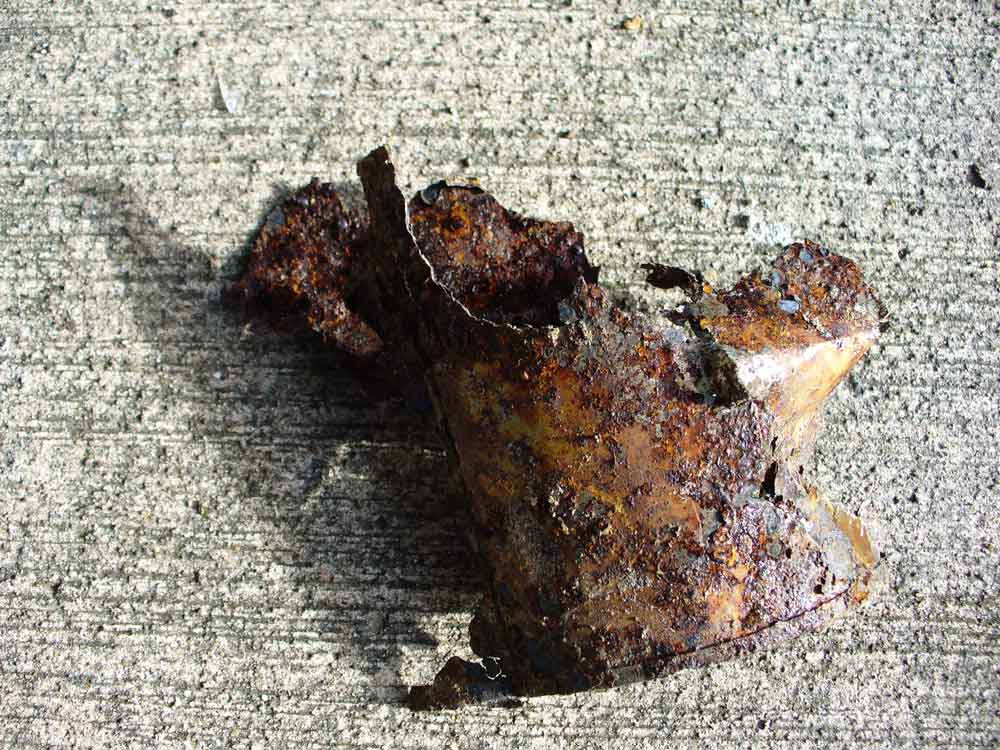
I wonder how long before this would not hold together at all..... Wouldn't it be interesting to bury a can, and dig it up every 5 years or so? To see what happened to it?
What cool textures!

I did not dig, though I did move some objects -- turning the most dangerous-looking glass over, for example, so no one's dog got a nasty cut. The dirt pile was easily within leash-length of the sidewalk, and there were small pieces of broken glass as far from the ditch as the sidewalk itself.
I only observed what was visible, rather than digging through the excavated dirt.
But. I saw no evidence of garbage at all. No bones, no pits (peach pits, say). I saw no aluminum. No plastic containers. Just this minute I took a quick look -- aluminum pop cans took over in the 1960s. So -- no aluminum may indicate that the date is 1965 or earlier? Assuming the aluminum would still be recognizable, after decades in the damp ground? On the other hand, that insulator thing would have been much older than that, assuming my identification of it was correct.
Ditch in the background, with ... shoe.

I'm pretty sure this is plastic. I don't think leather would have survived. It's dirty, and part of it has rotted away. I conclude it was buried, but was it buried as long as the rest of the stuff? I have no idea.

This is the only plastic I saw (other than the cup bottom near the top of this post, which might well have been very new indeed (dropped by the ditch diggers?).
I found all of this to be very confusing. Why was it here? How old was it? One burial, or many?
I have seen older items come out of the ground near an older house. My first house was built in 1880, and I bought it in 1980. I have seen older bottles come out of the ground, and older ceramics, too.
My guesstimate would be that this stuff went into the ground 45 years ago, plus or minus 5 years?. (How old *are* plastic shoes, anyway? I don't know.... I'm guessing not much older than 30 years?) I owned glass Noxema jars, 40 years ago.
I don't know when public garbage collection began, but I know Ann Arbor was doing it in the 50s and 60s.
My guess is that this stuff went into the ground when public garbage collection was available.
So -- why is it here? This collection isn't an item or two. There are so many different items. Odd, very odd.
I suppose there's no reason to think that this stuff is all the same age, but its presence is so anomalous. It's hard for me to imagine that people went out and buried trash in their yard many different times...... When all they had to do was put it in a garbage can! Back in the 1960s, in Ann Arbor, I think you didn't even have to take the can to the curb. I think they came and got the can, from near your back door or your garage, or wherever you kept it, took it to the truck, dumped it in the truck, and then brought it back. (Right, Mom and Dad? No?)
Why would anyone bury their trash, rather than just dumping it in a garbage can for publicly-funded trash-removal to handle? Baffling. Maybe this was some sort of time-capsule-y collection, buried for posterity, only to be destroyed by ditch-digging machinery? I wonder........
Many different thoughts arise, thanks to ADLS. Thoughts about how long different things survive, buried in the dirt, in Michigan, for several decades. Thoughts about how much archaeologists have learned from looking at people's discarded items, over the millenia. Thoughts about what, in all that trash, might be important and useful, as information for future archaeologists, and so should not be disturbed by looters. Or ditch diggers.........
On the other hand, there isn't enough time in the world for every item ever used by anyone to be drawn, photographed, measured, recorded. There isn't enough space in the world to reverently put every item on a shelf in a warehouse.
When/why is something Important? When/why is it Trash?
Who gets to decide?
One of the things we learned is that, sometimes, things will be dug up, drawn/photographed/measured/recorded, and then -- those things will be replaced in the ground and buried. When archaeologists re-bury stuff, they typically toss a modern object into the ground, so that future diggers will know the site was disturbed at the time of the modern object.
I tossed a penny into the ditch. A futile gesture, as I reconsider -- I wasn't thinking about metal not lasting long (relatively speaking!) in this environment.......... If I were an archaeologist, perhaps I'd get a friendly ceramist to make me some small disks with my name, location, and the date inscribed, so I had something really informative to toss into the ground where I had dug.......
I'm not usually out and about much before noon, but I'd seen that ditch the night before, and had taken a couple of pics. The more I thought about it, the more I wanted to record the ditch itself, and take more pics, so I got up and got going on the 9th.
The 9th was another of our beautiful Michigan summer days!

.
Sorry for my absence yesterday -- Blogger was broken and wouldn't let me upload any pics.....
This property is on my normal one-mile walking loop, and is on the corner where I turn back toward our house with Wilbur when he and I are walking our two-block loop.
They are doing something with the plumbing, about three or four feet below the surface. We note the orange snow fencing, and take a desultory look into the ditch. There is LOTS of plumbing work going on in the neighborhood. Some set of idiots decided it was ok for us to have cardboard sewer pipes, when the neighborhood was built, and -- big surprise! -- those cheap pipes are failing. Many people have replaced sewer pipes over the course of this summer.
So -- ditches and plumbing work have become ho-hum; we don't pay particular notice. (I don't know that's what's happening here; it's just why we don't regard this sort of activity as unusual.)
The pipe needs to go under the sidewalk. The ditch comes right up to the edges of the sidewalk, on both sides.
Flowers on the dirty sidewalk. Someone must have picked this, and then dropped it here.....
Looking down into the ditch. Trash. Still, we're not thinking anything out of the ordinary is going on here.
After we round the corner, as we head up the hill, parallel to the main part of the ditch, we glance at the pile of dirt that has come out of the ditch.
Wait a minute. We take a closer look. There is LOT of trash in with the dirt. I mean a **LOT** of trash.
Look how dense it is. Seven items in a space less than two feet wide. That's a beer-bottle-size brown bottle. These seven pieces of trash come from at least three different items -- a clear glass bottle, a brown bottle, and a steel can, and maybe they came from more than three items.
Now our interest is piqued. We look more closely, and we see more and more different items represented. Pottery. Lots of pottery.
Some metal stuff, but much more pottery.
Even more glass than pottery.
Glass cup?
I turned it over -- obviously not a cup. Look how thick the glass is! I'm thinking this is one of those insulator things that used to be on telephone poles to hold the wires.......
Yikes.
Glass and more and more glass.
I am no expert, but I am thinking all of this is relatively new. Noxema doesn't come in glass anymore, but I bet this was a Noxema jar.
In Archaeology's Dirty Little Secrets, we heard about which objects survive when buried in different sorts of environments. Glass and pottery hold up better than anything except stone. Metal is more fragile, if the environment is wet. (We did not hear about any digging so recent that it could have included aluminum items... I wonder how aluminum holds up, in wet dirt....)
Michigan has a temperate climate. The ground is damp, or wet, most of the time, especially three or four feet below the surface. Steel cans don't last long, compared to bottles and ceramics..... (I moved this can onto the sidewalk to take its pic, and then returned it whence it came.)
I wonder how long before this would not hold together at all..... Wouldn't it be interesting to bury a can, and dig it up every 5 years or so? To see what happened to it?
What cool textures!
I did not dig, though I did move some objects -- turning the most dangerous-looking glass over, for example, so no one's dog got a nasty cut. The dirt pile was easily within leash-length of the sidewalk, and there were small pieces of broken glass as far from the ditch as the sidewalk itself.
I only observed what was visible, rather than digging through the excavated dirt.
But. I saw no evidence of garbage at all. No bones, no pits (peach pits, say). I saw no aluminum. No plastic containers. Just this minute I took a quick look -- aluminum pop cans took over in the 1960s. So -- no aluminum may indicate that the date is 1965 or earlier? Assuming the aluminum would still be recognizable, after decades in the damp ground? On the other hand, that insulator thing would have been much older than that, assuming my identification of it was correct.
Ditch in the background, with ... shoe.
I'm pretty sure this is plastic. I don't think leather would have survived. It's dirty, and part of it has rotted away. I conclude it was buried, but was it buried as long as the rest of the stuff? I have no idea.
This is the only plastic I saw (other than the cup bottom near the top of this post, which might well have been very new indeed (dropped by the ditch diggers?).
I found all of this to be very confusing. Why was it here? How old was it? One burial, or many?
I have seen older items come out of the ground near an older house. My first house was built in 1880, and I bought it in 1980. I have seen older bottles come out of the ground, and older ceramics, too.
My guesstimate would be that this stuff went into the ground 45 years ago, plus or minus 5 years?. (How old *are* plastic shoes, anyway? I don't know.... I'm guessing not much older than 30 years?) I owned glass Noxema jars, 40 years ago.
I don't know when public garbage collection began, but I know Ann Arbor was doing it in the 50s and 60s.
My guess is that this stuff went into the ground when public garbage collection was available.
So -- why is it here? This collection isn't an item or two. There are so many different items. Odd, very odd.
I suppose there's no reason to think that this stuff is all the same age, but its presence is so anomalous. It's hard for me to imagine that people went out and buried trash in their yard many different times...... When all they had to do was put it in a garbage can! Back in the 1960s, in Ann Arbor, I think you didn't even have to take the can to the curb. I think they came and got the can, from near your back door or your garage, or wherever you kept it, took it to the truck, dumped it in the truck, and then brought it back. (Right, Mom and Dad? No?)
Why would anyone bury their trash, rather than just dumping it in a garbage can for publicly-funded trash-removal to handle? Baffling. Maybe this was some sort of time-capsule-y collection, buried for posterity, only to be destroyed by ditch-digging machinery? I wonder........
Many different thoughts arise, thanks to ADLS. Thoughts about how long different things survive, buried in the dirt, in Michigan, for several decades. Thoughts about how much archaeologists have learned from looking at people's discarded items, over the millenia. Thoughts about what, in all that trash, might be important and useful, as information for future archaeologists, and so should not be disturbed by looters. Or ditch diggers.........
On the other hand, there isn't enough time in the world for every item ever used by anyone to be drawn, photographed, measured, recorded. There isn't enough space in the world to reverently put every item on a shelf in a warehouse.
When/why is something Important? When/why is it Trash?
Who gets to decide?
One of the things we learned is that, sometimes, things will be dug up, drawn/photographed/measured/recorded, and then -- those things will be replaced in the ground and buried. When archaeologists re-bury stuff, they typically toss a modern object into the ground, so that future diggers will know the site was disturbed at the time of the modern object.
I tossed a penny into the ditch. A futile gesture, as I reconsider -- I wasn't thinking about metal not lasting long (relatively speaking!) in this environment.......... If I were an archaeologist, perhaps I'd get a friendly ceramist to make me some small disks with my name, location, and the date inscribed, so I had something really informative to toss into the ground where I had dug.......
I'm not usually out and about much before noon, but I'd seen that ditch the night before, and had taken a couple of pics. The more I thought about it, the more I wanted to record the ditch itself, and take more pics, so I got up and got going on the 9th.
The 9th was another of our beautiful Michigan summer days!
.
Friday, August 02, 2013
Tuesday, July 30, 2013
July 23
.
The 23rd was "just packed."
I started with a dentist appointment. While I was waiting, I leafed through Martha Stewart Living, and discovered an article on salt-packed capers. My daughter learned a lot about capers (and salt-packing them) when she was on the Italian island Pantelleria last fall....
Then it was my turn to get clean teeth -- and the hygienist found a crack in one of my molars, indicating the need for yet another crown. Sigh....................
It had rained during the night, and had looked like it might rain when I went to the dentist's office, but at lunch time the sky was clear and blue.
I had lunch with my work buddies. I always have a good time with them! It was good to find out what they and their families are up to, and what's going on at work. I don't mind missing the mandatory HR how-to-be-more-PC-in-the-workplace meetings. Especially as that's a pretty darn PC place to work, and I bet no one learned anything useful!
After lunch, I visited the University's Kelsey Museum of Archaeology, to fulfill my final assignment for Archaeology's Dirty Little Secrets. (The assignment choice was to visit an archaeological site, monument, or museum, and write up that visit.)
The last archaeology museum I visited was the University of Pennsylvania's Museum, which is world-class. The Kelsey is a nice little museum, but it's not up there with the British Museum..... Lots more fragments (as opposed to intact objects) at the Kelsey. Nothing that made me think "I've seen this in (the book version of) A History of the World in 100 Objects!"
Ah well -- we are where we are -- let's enjoy it for what it is.
Blown glass bird-shaped perfume bottles. ("1st-2nd century AD, Puteoli, Italy") Wouldn't it have been fun to watch this artisan at work? I've seen lots of solid glass animals, but am not sure I've seen blown glass animals....

22-27 are glass game pieces. ("1st-5th century AD, Egypt." -- with that skimpy info, I'm supposing the context for these objects was lost.....)

Glass bangles. (with shadows!) ("8th-10th century AD or later. Egypt." Even worse than the previous, for lost context. Very sad -- so much of what we could have known about these objects and what they had to say about the people who made them and used them is apparently gone.....)

Cool slaunchy jug. I love the lean, and I love the way the rather precise bottle contrasts with the very fluid handle. ("1st-2nd century AD. Egypt")

More jugs. (#3 "Core-formed pitcher. 5th century BC. Syria(?)" #4 "Free-blown jug. 4th-5th century AD. Egypt." Again we note a sad lack of context. Syria-with-a-question-mark, and ... Egypt is a big place.........)

I had heard of 2000-yr-old lentils, but hadn't known anyone had found this variety of ancient foodstuffs. ("1-4th century AD. Karanis, Egypt") #16 – peach pits, #17 – peas, #18 – garlic, #19 – gourd, #20 – lentils, according to the legend. I think #20 looks a lot more like peppercorns than lentils! Nothing lentil-shaped about these! (26 is a fragment of linen cloth, and 27 is partly linen and partly wool.)
I wonder if any of these seeds would grow.....

Amphora. The Kelsey has a lot of intact amphorae. This is working on being a yard tall, I think. ("Olive Oil Amphora (Brindisi Type). Roman Period (late 2nd-early 1st century BC). Origin: Apulia, Italy; findspot: Karanis, Egypt. This amphora originated in southern Italy. One handle is stamped HRAIOC, the name of a Greek who may have been a slave-potter, and the other with the Latin name of BATON, who was prbably a member of the amphora workshop of C. Aninias at Apani in Apulia. These stamps also help document the trade in oil. THe HRAIOC stamp has been found at several sites in Apulia, in Egypt including Alexandria and the Fayum, and in Portugal. The BATON stamp is known in Marseille in the south of France.")
LOTS of into about this one, in comparison to the little glass objects above! This is the first time I've noticed info about the "findspot" as well as the origin of the object.

I took this pic because I thought these were odd, for Roman ceramics. My perspicacious better half asked me where they were from, and only then did I read the label (captured in a pic) and discover they were made in Cologne, Germany. Well then! They (particularly the one on the right) look very Germanic to me. No wonder I thought they looked odd for "Roman"..........
("Black-slipped Beaker. Roman Period (mid 2nd-early 4th century AD. Cologne, Germany" "The letters once read SVCEME, a greeting that perhaps translates as 'Taste Me.' ")

Professor Laurel Bestock is one of Sue Alcock's colleagues at Brown University. I mentioned that Sue interviewed her colleagues about each unit's archaeological topic, allowing us to hear about the differences in doing their work in totally different parts of the world. Dr. B. works in Abydos, in Egypt. She told us that almost everything is preserved perfectly in Egypt, with the exception of wood. There are termites in Egypt which almost always get the wood.
So I was surprised to see several wooden objects from Egypt at the Kelsey.
I'd seen this sort of conical glass vessel before, but never was sure what they were for. I'd certainly never seen a stand for one, until the 23rd. ("Conical Lamp in Stand; glass, wood; Roman Period (1st-4th centuries AD); Karanis, Egypt")

("Box with Lid. Wood. Roman Period (1st-4th century AD). Karanis, Egypt.")

("Bust of Serapis (Furniture Ornament). Wood, clay, gold leaf. Roman Period (late 2nd-early 3rd century AD. Fayum Region, Egypt.")

Ancient flip-flop, with knife blade. ("Knife Blade. Bronze." and "Sandal. Palm Fiber." both from "Roman Period (1st-4th century AD). Karanis, Egypt.")

I liked the big leafy decoration on the side of this big Greek pot (it must be over 2' tall). (I failed to capture the info describing this one.)

I saw the big swirly stuff, and the white dots, but didn't notice the very fluid sketchy lines in the woman's garment until I saw this "on the big screen"......... Interesting, all the different sorts of decoration (including the squared-off stuff near the bottom).....

Very modern-looking owl. (#18 "Drinking Cup (Skyphos) with Owl. Clay, Attic red figure. Ca. 450-400 BC" #20 "Athenian Coin (Obverse: Athena). Silver tetradrachm. 449-413 BC.") The info said that owls are symbolic of Athena (and, therefore, Athens) but there was no info about where these were made or found.....

We were told coins are "the archaeologists' friends" as they so often make it possible to date things quite precisely. #20 has the most precise date of anything I saw on the 23rd.
I admired the decoration on this pot. One can get neat circles and spirals by putting an object on the potter’s wheel and slowly spinning the wheel, touching the object with a brush loaded with iron oxide (in water) as it (and the wheel) spin. I wonder if that’s how this pot was decorated, all those years ago. ("Iron Age Pottery, Cypro-Geometric-Cypro-Archaic, 1050-480 BC")

I stopped in at the Kelsey's gift shop, and had a nice chat with someone I know from the local wool (and other fibers) spinning guild. She's been working at the Kelsey for a long time. She told me that one of the guys who works there also works at Abydos. I bet he knows Dr. Bestock (but maybe not, I know Abydos is a really big site).
Time to go home.
Oh. Goodness. The sky was bright and blue when I walked into the museum; I wasn't expecting to step out and find this!
It's not actually raining. Yet. Let's see if I can make it to the library (a few blocks from the Kelsey).

Cool chartreuse plants outside the Kelsey. You can tell I wasn't TOO worried about making it to the library.

There's half an hour between the previous pic and the next one. I should have hustled to the library instead of taking pics of cool plants................
The minute it started to rain I put the camera in the zip-lock bag that lives (with the camera, the extra batteries, and the extra memory chip) in my fanny pack.
As I got to the corner of William and Division, the sky opened up. From there to the middle of the next block west, where the University of Michigan's Credit Union is, I got DRENCHED. I dodged into the Credit Union to wait for the rain to stop. I was totally soaked from the waist up (and "merely wet" below -- except for my feet,which were drenched).
I really wish I could have taken some pics through the Credit Union windows. There is an asphalt parking lot right outside the door. I could see the big drops of rain rebounding up from that dark pavement........ But I was absolutely dripping, and didn't see how I could possibly touch the camera without getting it wetter than it would like to be........
Then the sun came out, while it was still pouring right down, and you could see the rebound from the drops even more clearly. Annoying, to be too wet to feel it would be safe for the camera if I were to use it!
Ah well.
The rain stopped, and I walked on home. I was glad for even intermittent sunshine; it was a very pleasant temperature on the 23rd, and, since I was all wet, I felt a bit cool.
Love these colors together. Coneflowers, with grass.


Wet daylilies.

Love these long skinny curvy petals.

I know I walked Willard when I got home, and I think it had clouded back up by then, but I didn't take any more pictures, so I can't remember any more of what happened on the 23rd. I guess what I've already told you is enough to be "a pretty exciting day."
.
The 23rd was "just packed."
I started with a dentist appointment. While I was waiting, I leafed through Martha Stewart Living, and discovered an article on salt-packed capers. My daughter learned a lot about capers (and salt-packing them) when she was on the Italian island Pantelleria last fall....
Then it was my turn to get clean teeth -- and the hygienist found a crack in one of my molars, indicating the need for yet another crown. Sigh....................
It had rained during the night, and had looked like it might rain when I went to the dentist's office, but at lunch time the sky was clear and blue.
I had lunch with my work buddies. I always have a good time with them! It was good to find out what they and their families are up to, and what's going on at work. I don't mind missing the mandatory HR how-to-be-more-PC-in-the-workplace meetings. Especially as that's a pretty darn PC place to work, and I bet no one learned anything useful!
After lunch, I visited the University's Kelsey Museum of Archaeology, to fulfill my final assignment for Archaeology's Dirty Little Secrets. (The assignment choice was to visit an archaeological site, monument, or museum, and write up that visit.)
The last archaeology museum I visited was the University of Pennsylvania's Museum, which is world-class. The Kelsey is a nice little museum, but it's not up there with the British Museum..... Lots more fragments (as opposed to intact objects) at the Kelsey. Nothing that made me think "I've seen this in (the book version of) A History of the World in 100 Objects!"
Ah well -- we are where we are -- let's enjoy it for what it is.
Blown glass bird-shaped perfume bottles. ("1st-2nd century AD, Puteoli, Italy") Wouldn't it have been fun to watch this artisan at work? I've seen lots of solid glass animals, but am not sure I've seen blown glass animals....
22-27 are glass game pieces. ("1st-5th century AD, Egypt." -- with that skimpy info, I'm supposing the context for these objects was lost.....)
Glass bangles. (with shadows!) ("8th-10th century AD or later. Egypt." Even worse than the previous, for lost context. Very sad -- so much of what we could have known about these objects and what they had to say about the people who made them and used them is apparently gone.....)
Cool slaunchy jug. I love the lean, and I love the way the rather precise bottle contrasts with the very fluid handle. ("1st-2nd century AD. Egypt")
More jugs. (#3 "Core-formed pitcher. 5th century BC. Syria(?)" #4 "Free-blown jug. 4th-5th century AD. Egypt." Again we note a sad lack of context. Syria-with-a-question-mark, and ... Egypt is a big place.........)
I had heard of 2000-yr-old lentils, but hadn't known anyone had found this variety of ancient foodstuffs. ("1-4th century AD. Karanis, Egypt") #16 – peach pits, #17 – peas, #18 – garlic, #19 – gourd, #20 – lentils, according to the legend. I think #20 looks a lot more like peppercorns than lentils! Nothing lentil-shaped about these! (26 is a fragment of linen cloth, and 27 is partly linen and partly wool.)
I wonder if any of these seeds would grow.....
Amphora. The Kelsey has a lot of intact amphorae. This is working on being a yard tall, I think. ("Olive Oil Amphora (Brindisi Type). Roman Period (late 2nd-early 1st century BC). Origin: Apulia, Italy; findspot: Karanis, Egypt. This amphora originated in southern Italy. One handle is stamped HRAIOC, the name of a Greek who may have been a slave-potter, and the other with the Latin name of BATON, who was prbably a member of the amphora workshop of C. Aninias at Apani in Apulia. These stamps also help document the trade in oil. THe HRAIOC stamp has been found at several sites in Apulia, in Egypt including Alexandria and the Fayum, and in Portugal. The BATON stamp is known in Marseille in the south of France.")
LOTS of into about this one, in comparison to the little glass objects above! This is the first time I've noticed info about the "findspot" as well as the origin of the object.
I took this pic because I thought these were odd, for Roman ceramics. My perspicacious better half asked me where they were from, and only then did I read the label (captured in a pic) and discover they were made in Cologne, Germany. Well then! They (particularly the one on the right) look very Germanic to me. No wonder I thought they looked odd for "Roman"..........
("Black-slipped Beaker. Roman Period (mid 2nd-early 4th century AD. Cologne, Germany" "The letters once read SVCEME, a greeting that perhaps translates as 'Taste Me.' ")
Professor Laurel Bestock is one of Sue Alcock's colleagues at Brown University. I mentioned that Sue interviewed her colleagues about each unit's archaeological topic, allowing us to hear about the differences in doing their work in totally different parts of the world. Dr. B. works in Abydos, in Egypt. She told us that almost everything is preserved perfectly in Egypt, with the exception of wood. There are termites in Egypt which almost always get the wood.
So I was surprised to see several wooden objects from Egypt at the Kelsey.
I'd seen this sort of conical glass vessel before, but never was sure what they were for. I'd certainly never seen a stand for one, until the 23rd. ("Conical Lamp in Stand; glass, wood; Roman Period (1st-4th centuries AD); Karanis, Egypt")
("Box with Lid. Wood. Roman Period (1st-4th century AD). Karanis, Egypt.")
("Bust of Serapis (Furniture Ornament). Wood, clay, gold leaf. Roman Period (late 2nd-early 3rd century AD. Fayum Region, Egypt.")
Ancient flip-flop, with knife blade. ("Knife Blade. Bronze." and "Sandal. Palm Fiber." both from "Roman Period (1st-4th century AD). Karanis, Egypt.")
I liked the big leafy decoration on the side of this big Greek pot (it must be over 2' tall). (I failed to capture the info describing this one.)
I saw the big swirly stuff, and the white dots, but didn't notice the very fluid sketchy lines in the woman's garment until I saw this "on the big screen"......... Interesting, all the different sorts of decoration (including the squared-off stuff near the bottom).....
Very modern-looking owl. (#18 "Drinking Cup (Skyphos) with Owl. Clay, Attic red figure. Ca. 450-400 BC" #20 "Athenian Coin (Obverse: Athena). Silver tetradrachm. 449-413 BC.") The info said that owls are symbolic of Athena (and, therefore, Athens) but there was no info about where these were made or found.....
We were told coins are "the archaeologists' friends" as they so often make it possible to date things quite precisely. #20 has the most precise date of anything I saw on the 23rd.
I admired the decoration on this pot. One can get neat circles and spirals by putting an object on the potter’s wheel and slowly spinning the wheel, touching the object with a brush loaded with iron oxide (in water) as it (and the wheel) spin. I wonder if that’s how this pot was decorated, all those years ago. ("Iron Age Pottery, Cypro-Geometric-Cypro-Archaic, 1050-480 BC")
I stopped in at the Kelsey's gift shop, and had a nice chat with someone I know from the local wool (and other fibers) spinning guild. She's been working at the Kelsey for a long time. She told me that one of the guys who works there also works at Abydos. I bet he knows Dr. Bestock (but maybe not, I know Abydos is a really big site).
Time to go home.
Oh. Goodness. The sky was bright and blue when I walked into the museum; I wasn't expecting to step out and find this!
It's not actually raining. Yet. Let's see if I can make it to the library (a few blocks from the Kelsey).
Cool chartreuse plants outside the Kelsey. You can tell I wasn't TOO worried about making it to the library.
There's half an hour between the previous pic and the next one. I should have hustled to the library instead of taking pics of cool plants................
The minute it started to rain I put the camera in the zip-lock bag that lives (with the camera, the extra batteries, and the extra memory chip) in my fanny pack.
As I got to the corner of William and Division, the sky opened up. From there to the middle of the next block west, where the University of Michigan's Credit Union is, I got DRENCHED. I dodged into the Credit Union to wait for the rain to stop. I was totally soaked from the waist up (and "merely wet" below -- except for my feet,which were drenched).
I really wish I could have taken some pics through the Credit Union windows. There is an asphalt parking lot right outside the door. I could see the big drops of rain rebounding up from that dark pavement........ But I was absolutely dripping, and didn't see how I could possibly touch the camera without getting it wetter than it would like to be........
Then the sun came out, while it was still pouring right down, and you could see the rebound from the drops even more clearly. Annoying, to be too wet to feel it would be safe for the camera if I were to use it!
Ah well.
The rain stopped, and I walked on home. I was glad for even intermittent sunshine; it was a very pleasant temperature on the 23rd, and, since I was all wet, I felt a bit cool.
Love these colors together. Coneflowers, with grass.
Wet daylilies.
Love these long skinny curvy petals.
I know I walked Willard when I got home, and I think it had clouded back up by then, but I didn't take any more pictures, so I can't remember any more of what happened on the 23rd. I guess what I've already told you is enough to be "a pretty exciting day."
.
Monday, July 29, 2013
class notes
.
I did my last peer reviewing for Archaeology's Dirty Little Secrets on the 27th. I have completed all the requirements; once the dust settles, I should be getting a certificate of completion (by whatever name).
It was a really good class. Professor Sue Alcock at Brown University excels at what she does. Should you ever get a chance to take a class from her, advice from here is to jump at that opportunity!
One of the downsides to experiencing something done in a superb way is that our expectations rise, and other (similar) things/experiences suffer in comparison.
It is not a surprise that my new class isn't as good as the last one. It's not bad, but ... it's not holding a candle to Archaeology's Dirty Little Secrets.
Alas.
.
I did my last peer reviewing for Archaeology's Dirty Little Secrets on the 27th. I have completed all the requirements; once the dust settles, I should be getting a certificate of completion (by whatever name).
It was a really good class. Professor Sue Alcock at Brown University excels at what she does. Should you ever get a chance to take a class from her, advice from here is to jump at that opportunity!
One of the downsides to experiencing something done in a superb way is that our expectations rise, and other (similar) things/experiences suffer in comparison.
It is not a surprise that my new class isn't as good as the last one. It's not bad, but ... it's not holding a candle to Archaeology's Dirty Little Secrets.
Alas.
.
Wednesday, July 24, 2013
class update
.
Working along on my classes, as Archaeology's Dirty Little Secrets overlaps Maps and the Geospatial Revolution.
Monday (22nd) I took a quiz for each class. I believe that's the first time I've taken two quizzes in one day, in two different subjects, since 1974!
I just turned in my last assignment for Archaeology. We have to do 6 of 8 assignments to have "completed" the class. I have found interesting options in 6 of 8 weeks, so that was perfect for me. One choice for week 7 is visiting an archaeological site or monument or museum. The University has a museum handy for me to visit, so I did that yesterday, and wrote it up today.
For every assignment we turn in, we have to review the assignments of five of our classmates, so I still have that to do, and then I'll have finished the class.
It was a great class. Extremely well thought out, and extremely well executed. I urge anyone with any interest in archaeology to take it the next time it is offered!
Remember that Coursera classes are free, and know that all the profs I've had have specifically encouraged anyone who has any interest in their topics to do as much -- or as little -- of the classwork as they want and/or are able to do. If you only have time to watch one video a week, they would love to have you do that...........
(At least) one of my Archaeology classmates is 85 -- she thinks everyone should take advantage of Coursera. :-)
Professor Sue Alcock does an absolutely fabulous job with Dirty Little Secrets. I would totally take classes from her, if I went to Brown! I'm sorry the class has ended.
As for Maps, I was caught up until this morning, when Lesson 2 began. I have some work to do for my volunteer gig, so I should probably do that before I start on the Maps Lesson 2 material.
I'm sorry Archaeology is over, but I'll be glad to only have one class to keep up with.
I seriously love being able to dabble like this, in such a wide variety of classes! Use of mathematical models for thinking about problems, thinking/reasoning and analyzing arguments, archaeology, geography/maps.............. What fun! No worries about requirements or cognates or any of that, just following my fancy.........
Excellent!
.
Working along on my classes, as Archaeology's Dirty Little Secrets overlaps Maps and the Geospatial Revolution.
Monday (22nd) I took a quiz for each class. I believe that's the first time I've taken two quizzes in one day, in two different subjects, since 1974!
I just turned in my last assignment for Archaeology. We have to do 6 of 8 assignments to have "completed" the class. I have found interesting options in 6 of 8 weeks, so that was perfect for me. One choice for week 7 is visiting an archaeological site or monument or museum. The University has a museum handy for me to visit, so I did that yesterday, and wrote it up today.
For every assignment we turn in, we have to review the assignments of five of our classmates, so I still have that to do, and then I'll have finished the class.
It was a great class. Extremely well thought out, and extremely well executed. I urge anyone with any interest in archaeology to take it the next time it is offered!
Remember that Coursera classes are free, and know that all the profs I've had have specifically encouraged anyone who has any interest in their topics to do as much -- or as little -- of the classwork as they want and/or are able to do. If you only have time to watch one video a week, they would love to have you do that...........
(At least) one of my Archaeology classmates is 85 -- she thinks everyone should take advantage of Coursera. :-)
Professor Sue Alcock does an absolutely fabulous job with Dirty Little Secrets. I would totally take classes from her, if I went to Brown! I'm sorry the class has ended.
As for Maps, I was caught up until this morning, when Lesson 2 began. I have some work to do for my volunteer gig, so I should probably do that before I start on the Maps Lesson 2 material.
I'm sorry Archaeology is over, but I'll be glad to only have one class to keep up with.
I seriously love being able to dabble like this, in such a wide variety of classes! Use of mathematical models for thinking about problems, thinking/reasoning and analyzing arguments, archaeology, geography/maps.............. What fun! No worries about requirements or cognates or any of that, just following my fancy.........
Excellent!
.
Thursday, July 18, 2013
Maps, and the Geospatial Revolution
.
My Maps class started yesterday.
Here's an interview with the prof.....
I didn't have time to start, yesterday. I had a bunch of work to do for my volunteer gig, and I needed to take the Unit 7 quiz for Archaeology's Dirty Little Secrets (got a perfect score, huzzah!). I also needed to grade five other students' assignments for Unit 5. I'm still not digging doing that reviewing. (Heh, heh, heh, get it? "Digging" grading archaeology assignments? Heh, heh, heh........)
Anyway. At present I have caught up in Archaeology, and I'm ready for Maps!
I went to Staples a couple of days ago for a composition book, and was quietly thrilled to find this map-like cover.

Composition books were on sale, so now I'm ready for my next three on-line classes after Maps, too -- whatever they may be! (I'm signed up for Roman Architecture, but that doesn't start until January).......
So excellent to be able to take whatever suits your fancy, with no need to consider requirements or cognates or expense, even! For someone like me, who is interested in an awful lot of things, this is totally the bees knees!
.
My Maps class started yesterday.
Here's an interview with the prof.....
I didn't have time to start, yesterday. I had a bunch of work to do for my volunteer gig, and I needed to take the Unit 7 quiz for Archaeology's Dirty Little Secrets (got a perfect score, huzzah!). I also needed to grade five other students' assignments for Unit 5. I'm still not digging doing that reviewing. (Heh, heh, heh, get it? "Digging" grading archaeology assignments? Heh, heh, heh........)
Anyway. At present I have caught up in Archaeology, and I'm ready for Maps!
I went to Staples a couple of days ago for a composition book, and was quietly thrilled to find this map-like cover.
Composition books were on sale, so now I'm ready for my next three on-line classes after Maps, too -- whatever they may be! (I'm signed up for Roman Architecture, but that doesn't start until January).......
So excellent to be able to take whatever suits your fancy, with no need to consider requirements or cognates or expense, even! For someone like me, who is interested in an awful lot of things, this is totally the bees knees!
.
Sunday, July 14, 2013
really old underwear
.
I happened across this article about 15th century underwear while poking around in the readings for Archaeology's Dirty Little Secrets.
.
I happened across this article about 15th century underwear while poking around in the readings for Archaeology's Dirty Little Secrets.
.
Monday, July 01, 2013
Archaeology news
.
This week's Archaeology's Dirty Little Secrets unit is on "what do you do with the stuff you find?"
One of the articles we are to read is about archaeologists testing their ideas about how something might have worked, by doing [whatever] themselves. Kon-Tiki is an extreme instance.
The article includes a flute made from a swan bone.
"Not long after the first figurative carvings appear in the archaeological record about 35,000 years ago, so do the first musical instruments."
(Digression -- I wish "they" would always be careful to say "the earliest known" rather than "the first"................... End of Digression.)
At the end of the flute info, there is a url for a recording of someone playing a swan-bone flute. The flute player really knows how to play that kind of flute. The result is musical and appealing. I can almost hear the camp-fire crackling, as someone else drums an accompaniment to the flute.....
I think that I have given you a link to the article which will show the whole article, but if you only see the section on flutes, look for a "view all," which will let you see info about Kon-Tiki, the first known noodles, a recreation of a Viking boat that was sailed by a crew of 63 men and women from Denmark to Dublin, Ireland, and several other interesting recreations.
Pondering my Coursera class experience, I think the things I learned in Model Thinking were as interesting as the things I'm learning in Archaeology's Dirty Little Secrets, but, for me, the learning in DLS is much easier. There's no math for me to struggle with. Succeeding at Model Thinking was a personal triumph for me, because it was hard, but DLS is more fun (aside from grading other people's assignments, which I am really not enjoying).
Last week I happened across classes beginning soon at Coursera. I have signed up for Maps and the Geo-Spatial Revolution, which begins as DLS is ending. You might be amused by the teaser video for Maps -- I was. He quotes what he terms "the immortal words" of some beauty contestant: "Some people don't have any maps, and that's sad." Sad, indeed.
It's also sad that there is some sort of group work, or peer review, or something, required for Official Completion of Required work. I'm thinking I'm going to decline to participate in that aspect of the class...................
I love maps, and I love the newfangled things we can do with maps and geography, and I bet I'm going to like Maps (especially if I can actually get myself to NOT DO the parts that I think are icky, rather than doing them and wishing I weren't!).
.
This week's Archaeology's Dirty Little Secrets unit is on "what do you do with the stuff you find?"
One of the articles we are to read is about archaeologists testing their ideas about how something might have worked, by doing [whatever] themselves. Kon-Tiki is an extreme instance.
The article includes a flute made from a swan bone.
"Not long after the first figurative carvings appear in the archaeological record about 35,000 years ago, so do the first musical instruments."
(Digression -- I wish "they" would always be careful to say "the earliest known" rather than "the first"................... End of Digression.)
At the end of the flute info, there is a url for a recording of someone playing a swan-bone flute. The flute player really knows how to play that kind of flute. The result is musical and appealing. I can almost hear the camp-fire crackling, as someone else drums an accompaniment to the flute.....
I think that I have given you a link to the article which will show the whole article, but if you only see the section on flutes, look for a "view all," which will let you see info about Kon-Tiki, the first known noodles, a recreation of a Viking boat that was sailed by a crew of 63 men and women from Denmark to Dublin, Ireland, and several other interesting recreations.
Pondering my Coursera class experience, I think the things I learned in Model Thinking were as interesting as the things I'm learning in Archaeology's Dirty Little Secrets, but, for me, the learning in DLS is much easier. There's no math for me to struggle with. Succeeding at Model Thinking was a personal triumph for me, because it was hard, but DLS is more fun (aside from grading other people's assignments, which I am really not enjoying).
Last week I happened across classes beginning soon at Coursera. I have signed up for Maps and the Geo-Spatial Revolution, which begins as DLS is ending. You might be amused by the teaser video for Maps -- I was. He quotes what he terms "the immortal words" of some beauty contestant: "Some people don't have any maps, and that's sad." Sad, indeed.
It's also sad that there is some sort of group work, or peer review, or something, required for Official Completion of Required work. I'm thinking I'm going to decline to participate in that aspect of the class...................
I love maps, and I love the newfangled things we can do with maps and geography, and I bet I'm going to like Maps (especially if I can actually get myself to NOT DO the parts that I think are icky, rather than doing them and wishing I weren't!).
.
Tuesday, June 25, 2013
what's up in archaeology class?
.
As you'll have guessed from the material I sent you to earlier, about dendrochronology and time keeping, our theme this week is "how do you date stuff?"
It's been interesting to hear how dating is done at the various places we are hearing about each week (Petra, Abydos in Egypt, Montserrat in the Caribbean, and El Zotz [a Mayan site]). For example, Mayan dating is so precise that inscriptions are a better indication of date than radiocarbon dating.....
Here's a link to a newsletter article written by our professor, Sue Alcock, about Archaeology's Dirty Little Secrets.
The video/sound quality for this class is EXCELLENT. Sue is very organized and well prepared. The content is fascinating.
This is a really good class!
.
As you'll have guessed from the material I sent you to earlier, about dendrochronology and time keeping, our theme this week is "how do you date stuff?"
It's been interesting to hear how dating is done at the various places we are hearing about each week (Petra, Abydos in Egypt, Montserrat in the Caribbean, and El Zotz [a Mayan site]). For example, Mayan dating is so precise that inscriptions are a better indication of date than radiocarbon dating.....
Here's a link to a newsletter article written by our professor, Sue Alcock, about Archaeology's Dirty Little Secrets.
The video/sound quality for this class is EXCELLENT. Sue is very organized and well prepared. The content is fascinating.
This is a really good class!
.
Saturday, June 22, 2013
how old -- how long ago?
.
Next week's unit in Archaeology's Dirty Little Secrets is on how we decide how old stuff is. Here are some of the optional things for us to look at on this topic......
A brief history of time-telling, from the British Museum (click through and play the video).
Dendrochronology.........
'
Next week's unit in Archaeology's Dirty Little Secrets is on how we decide how old stuff is. Here are some of the optional things for us to look at on this topic......
A brief history of time-telling, from the British Museum (click through and play the video).
Dendrochronology.........
'
Wednesday, June 19, 2013
Dirty Little Secrets -- in cuneiform
.
I've always had a peripheral interest in cuneiform. I thought it would be cool to learn to read it -- until I paid attention to the fact that ancient clay tablets were not written in English.
Oh.
Right.......
I have no interest in learning Akkadian (or Sumarian, or Hittite)............
But wouldn't it be cool to be able to read the word "Hammurabi"? Or, wouldn't it be cool to be able to read whatever the most common word in Akkadian is? So you might recognize at least one word, when you looked at a clay tablet? I think it would be.........
Given this long-standing interest, I was quite pleased to discover that one of the assignment choices for Unit 2 of Archeology's Dirty Little Secrets is to write something in cuneiform!
Cuneiform is written in syllabograms -- each collection of wedge-shaped marks is a syllable. We were given a link to a long list of syllable/cuneiform pairs.
http://www.britishmuseum.org/pdf/cuneiform.pdf
At a minimum, we are to write our names.....
I looked at the list. No V. Hardly a surprise -- many current languages don't have V. No F........ Hmmm. At this point, I'm thinking writing my name may not be that great an idea.
Then I thought of the fact that cuneiform was not meant for English........
(Digression: Interestingly, as I looked for translation, I read that cuneiform was not very well suited to Akkadian, either! According to Wikipedia, "Cuneiform was in many ways unsuited to Akkadian: among its flaws was its inability to represent important phonemes in Semitic, including a glottal stop, pharyngeals, and emphatic consonants. In addition, cuneiform was a syllabary writing system — i.e. a consonant plus vowel comprised one writing unit — frequently inappropriate for a Semitic language made up of triconsonantal roots (i.e. three consonants plus any vowels)."
Standards are excellent, but sometimes slavish adherence to a standard can enough trouble that it might be worth it to abandon the standard...................
End of Digression.)
Back to the assignment -- I decided to write "dirty little secrets" in Akkadian.
It was easy to find an English->Akkadian dictionary online.
http://www.premiumwanadoo.com/cuneiform.languages/dictionary/search.php
Akkadian has S with an upside-down carat over it, and S with a dot under it. (The S in esu had one of those dots under it.) The list of syllable/cuneiform pairs at the British Museum doesn't have either; it just has plain S....
I don't know how a line over A (or E) affects which syllables I ought to have chosen (or if the ones I need is even in the list).
Soldiering on, despite these obstacles, I arrived at the following plan. The mostly-English text is from the dictionary, and the syllable/cuneiform pairs are from the British Museum's list.

I thought it might be cool to write 2013 under the words, but I changed my mind after trying to find out how to write 2013 -- according to Wikipedia, "The numerals 1 and 2 as well as 21–29, 31–39, 41–49 correspond with the counted in the grammatical gender, while the numerals 3–20, 30, 40 and 50 show gender polarity, i.e. if the counted noun is masculine, the numeral would be feminine and vice versa. This polarity is typical of the Semitic languages and appears also in classical Arabic for example. The numerals 60, 100 and 1000 don't change according to the gender of the counted noun. Counted nouns more than two appear in the plural form. However, body parts which occur in pairs appear in the dual form in Akkadian. e.g. šepum (foot) becomes šepān (two feet)."
All righty then. Never mind! Way more complexity needed to express a number than I wish to undertake! (Not to mention that "2013" introduces a completely different time-keeping scheme than than Hammurabi and Company would have been using!).
The course material included videos of people writing cuneiform on air-dry clay with a square-ended chopstick. We were shown how to make three wedge-shaped marks -- horizontal, vertical, and diagonal -- any of which may have long or short tails.
Attempting to copy the cuneiform above with a pen and paper, we notice right away that some of the marks have TWO tails. We were not shown how to make marks like that.... I'm guessing the stylus went into the wedge part of the shape twice, in each of two orientations, but I don't know..................
I bought some air-dry clay. I dug a square-ended chopstick out of the "miscellaneous kitchen tools" drawer.
Practice marks, with esu written at the bottom.

I wish I could have used real clay. I love real clay, but real clay requires a real kiln...... Air-dry "clay" has a completely different feel. It is much harder to smooth. It resists the marks (recovering a bit, rather than holding the mark-as-made). Erasing mistakes is something it's not interesting in facilitating.....
Without further ado -- dirty little secrets:

Wouldn't it be fun to know if one of those ancient scribes could read what I wrote, and understand what I meant?
Final impressions:
* The prep took WAY longer than the doing.
* Making these marks is easy and quick, but it would take even a very fast scribe a lot longer to write cuneiform than cursive English, say.
* I might change my mind if I were more familiar with a syllabographic language, but I'm thinking that a one-set-of-marks-per-sound system is simpler and cleaner than a one-set-of-marks-per-syllable system.
This was fun, and I'm glad I did it!
.
I've always had a peripheral interest in cuneiform. I thought it would be cool to learn to read it -- until I paid attention to the fact that ancient clay tablets were not written in English.
Oh.
Right.......
I have no interest in learning Akkadian (or Sumarian, or Hittite)............
But wouldn't it be cool to be able to read the word "Hammurabi"? Or, wouldn't it be cool to be able to read whatever the most common word in Akkadian is? So you might recognize at least one word, when you looked at a clay tablet? I think it would be.........
Given this long-standing interest, I was quite pleased to discover that one of the assignment choices for Unit 2 of Archeology's Dirty Little Secrets is to write something in cuneiform!
Cuneiform is written in syllabograms -- each collection of wedge-shaped marks is a syllable. We were given a link to a long list of syllable/cuneiform pairs.
http://www.britishmuseum.org/pdf/cuneiform.pdf
At a minimum, we are to write our names.....
I looked at the list. No V. Hardly a surprise -- many current languages don't have V. No F........ Hmmm. At this point, I'm thinking writing my name may not be that great an idea.
Then I thought of the fact that cuneiform was not meant for English........
(Digression: Interestingly, as I looked for translation, I read that cuneiform was not very well suited to Akkadian, either! According to Wikipedia, "Cuneiform was in many ways unsuited to Akkadian: among its flaws was its inability to represent important phonemes in Semitic, including a glottal stop, pharyngeals, and emphatic consonants. In addition, cuneiform was a syllabary writing system — i.e. a consonant plus vowel comprised one writing unit — frequently inappropriate for a Semitic language made up of triconsonantal roots (i.e. three consonants plus any vowels)."
Standards are excellent, but sometimes slavish adherence to a standard can enough trouble that it might be worth it to abandon the standard...................
End of Digression.)
Back to the assignment -- I decided to write "dirty little secrets" in Akkadian.
It was easy to find an English->Akkadian dictionary online.
http://www.premiumwanadoo.com/cuneiform.languages/dictionary/search.php
Akkadian has S with an upside-down carat over it, and S with a dot under it. (The S in esu had one of those dots under it.) The list of syllable/cuneiform pairs at the British Museum doesn't have either; it just has plain S....
I don't know how a line over A (or E) affects which syllables I ought to have chosen (or if the ones I need is even in the list).
Soldiering on, despite these obstacles, I arrived at the following plan. The mostly-English text is from the dictionary, and the syllable/cuneiform pairs are from the British Museum's list.

I thought it might be cool to write 2013 under the words, but I changed my mind after trying to find out how to write 2013 -- according to Wikipedia, "The numerals 1 and 2 as well as 21–29, 31–39, 41–49 correspond with the counted in the grammatical gender, while the numerals 3–20, 30, 40 and 50 show gender polarity, i.e. if the counted noun is masculine, the numeral would be feminine and vice versa. This polarity is typical of the Semitic languages and appears also in classical Arabic for example. The numerals 60, 100 and 1000 don't change according to the gender of the counted noun. Counted nouns more than two appear in the plural form. However, body parts which occur in pairs appear in the dual form in Akkadian. e.g. šepum (foot) becomes šepān (two feet)."
All righty then. Never mind! Way more complexity needed to express a number than I wish to undertake! (Not to mention that "2013" introduces a completely different time-keeping scheme than than Hammurabi and Company would have been using!).
The course material included videos of people writing cuneiform on air-dry clay with a square-ended chopstick. We were shown how to make three wedge-shaped marks -- horizontal, vertical, and diagonal -- any of which may have long or short tails.
Attempting to copy the cuneiform above with a pen and paper, we notice right away that some of the marks have TWO tails. We were not shown how to make marks like that.... I'm guessing the stylus went into the wedge part of the shape twice, in each of two orientations, but I don't know..................
I bought some air-dry clay. I dug a square-ended chopstick out of the "miscellaneous kitchen tools" drawer.
Practice marks, with esu written at the bottom.

I wish I could have used real clay. I love real clay, but real clay requires a real kiln...... Air-dry "clay" has a completely different feel. It is much harder to smooth. It resists the marks (recovering a bit, rather than holding the mark-as-made). Erasing mistakes is something it's not interesting in facilitating.....
Without further ado -- dirty little secrets:

Wouldn't it be fun to know if one of those ancient scribes could read what I wrote, and understand what I meant?
Final impressions:
* The prep took WAY longer than the doing.
* Making these marks is easy and quick, but it would take even a very fast scribe a lot longer to write cuneiform than cursive English, say.
* I might change my mind if I were more familiar with a syllabographic language, but I'm thinking that a one-set-of-marks-per-sound system is simpler and cleaner than a one-set-of-marks-per-syllable system.
This was fun, and I'm glad I did it!
.
Tuesday, June 11, 2013
rot or not, and cuneiform
.
This week's Archaeology's Dirty Little Secrets topic is "What has survived for us to find? And what have we lost?"
Dr. Alcock lectured about things that can make or break the archeological record. On one hand there is human activity, and on the other, natural (climatic and/or environmental) events.
Today I listened to (and watched) a conversation about what would happen to a collection of items if they were buried under the Brown University quad for 100 years, and what would happen to them if they were buried in Egypt for those 100 years.
The items they imagined burying included a doll in ethnic dress (plastic face, and the rest is all natural fibers); a modern claw hammer; an arrow with a glass point, a wooden shaft, and natural feather fletching; a ceramic bowl; a bronze bowl; beaded leather baby shoes; and a stone figure of a man riding a horse.
It is so dry in Egypt that things like feathers and food and fiber (cloth, papyrus) very often survive. The microorganisms that would cause decay can't survive in that dry climate.
It's so dry in Egypt that in the early days of mummification (before they really figured out what they were doing) a mummified body wouldn't last as long as an un-mummified one that was put straight into the sand. (!!!) The only natural problem that was mentioned in Egypt was termites, eating wood. (People destroying stuff -- primarily because they need the space -- is a huge problem in Egypt. We were told that every archaeological site in Egypt is at risk.........)
It's much wetter on the campus of Brown University (where Sue Alcock's day job is, which is why that location was featured).
In Egypt, wood buried 100 years would probably be gone, but everything else would be pristine. At Brown, the ceramic bowl and the glass arrowhead would survive (but might well be broken, buried in damp soil that would freeze and thaw), all the wood would be gone, as would the doll (aside from the plastic face), and the arrow's feathers. The bronze bowl would survive at Brown (but would be a lot more corroded), and in Egypt it "would survive for 1000 years, not just 100, and *might* have a bit of deterioration." The hammer head would be very rusty at Brown, and pristine in Egypt. The baby shoes would be fine in Egypt, but at Brown, only the beads would remain, and figuring out they had embellished baby shoes would be extremely problematic.
And the stone figure would be just fine everywhere...................
None of this is surprising (well, ok, termites in a very dry environment? I thought that was surprising....), but isn't it interesting to hear what sorts of things survive where? We also heard about a lot of Roman writing -- ink on birch tablets -- which survived at Vindolanda (near Hadrian's wall), because of the particular clay soil there, but which is vanishingly rare in the rest of the Roman empire..... The particular place things were abandoned has everything to do with whether they survive. Unless they are stone or ceramic in which case, they may survive regardless.
(Digression: What about glass, I wonder? It wasn't mentioned except in passing..... End of Digression.)
Another topic this week is cuneiform. Cuneiform is the script they used for writing on clay tablets, starting about 5000 years ago. Cuneiform was developed so people could write in Sumerian, but like the Roman alphabet it was used for many different languages, including Hittite and Akkadian.
If the tablets on which cuneiform was written were exposed to fire (deliberately or accidentally), they became impervious to weather in Babylon (Iraq). Hundreds of thousands of clay tablets have survived to this day (most of which have been put in drawers somewhere and never studied.....). The earliest of the clay tablets we have today were clerical -- a way to tally and keep track of beer and barley (if I remember correctly from A History of the World in 100 Objects....). Not long thereafter, there were historic texts, and literary texts. The Epic of Gilgamesh was written down in Sumerian, Hittite, and Akkadian (we have the tablets....).
Cuneiform means "wedge shaped" -- the stylus used to write cuneiform has square edges and corners. When one of those corners is pressed into damp clay, it leaves a wedge-shaped mark. A group of wedge-shaped marks make up a syllabogram -- which represents one syllable. (If you click through the cuneiform link, scroll down a bit to see the "all wedges, all the time" sort of script.)
(Digression: I knew there were writing systems where each symbol is a sound, and I knew there were writing systems where each symbol is a word, but I didn't know there were writing systems where each symbol is a syllable. Apparently Mayan script is also composed of syllabograms. End of Digression.)
We (and by "we" I mean "humankind") have cuneiform tablets written by children who were learning how to be scribes. Tablets full of vertical wedges. Tablets full of horizontal wedges. Tablets full of diagonal wedges. Tablets turned into squished handfuls of clay (by frustrated students?).
Cuneiform was in regular daily use from 3000 BCE ("before common era") to about 0 -- which means that the last regular users of cuneiform were (much!) closer in time to us than to the people who invented/developed cuneiform.
Wow, eh?
Isn't it cool that we know all this stuff?
I am finding this class to be so interesting! I would definitely listen to these lectures just for fun, and would read the readings, likewise!
.
This week's Archaeology's Dirty Little Secrets topic is "What has survived for us to find? And what have we lost?"
Dr. Alcock lectured about things that can make or break the archeological record. On one hand there is human activity, and on the other, natural (climatic and/or environmental) events.
Today I listened to (and watched) a conversation about what would happen to a collection of items if they were buried under the Brown University quad for 100 years, and what would happen to them if they were buried in Egypt for those 100 years.
The items they imagined burying included a doll in ethnic dress (plastic face, and the rest is all natural fibers); a modern claw hammer; an arrow with a glass point, a wooden shaft, and natural feather fletching; a ceramic bowl; a bronze bowl; beaded leather baby shoes; and a stone figure of a man riding a horse.
It is so dry in Egypt that things like feathers and food and fiber (cloth, papyrus) very often survive. The microorganisms that would cause decay can't survive in that dry climate.
It's so dry in Egypt that in the early days of mummification (before they really figured out what they were doing) a mummified body wouldn't last as long as an un-mummified one that was put straight into the sand. (!!!) The only natural problem that was mentioned in Egypt was termites, eating wood. (People destroying stuff -- primarily because they need the space -- is a huge problem in Egypt. We were told that every archaeological site in Egypt is at risk.........)
It's much wetter on the campus of Brown University (where Sue Alcock's day job is, which is why that location was featured).
In Egypt, wood buried 100 years would probably be gone, but everything else would be pristine. At Brown, the ceramic bowl and the glass arrowhead would survive (but might well be broken, buried in damp soil that would freeze and thaw), all the wood would be gone, as would the doll (aside from the plastic face), and the arrow's feathers. The bronze bowl would survive at Brown (but would be a lot more corroded), and in Egypt it "would survive for 1000 years, not just 100, and *might* have a bit of deterioration." The hammer head would be very rusty at Brown, and pristine in Egypt. The baby shoes would be fine in Egypt, but at Brown, only the beads would remain, and figuring out they had embellished baby shoes would be extremely problematic.
And the stone figure would be just fine everywhere...................
None of this is surprising (well, ok, termites in a very dry environment? I thought that was surprising....), but isn't it interesting to hear what sorts of things survive where? We also heard about a lot of Roman writing -- ink on birch tablets -- which survived at Vindolanda (near Hadrian's wall), because of the particular clay soil there, but which is vanishingly rare in the rest of the Roman empire..... The particular place things were abandoned has everything to do with whether they survive. Unless they are stone or ceramic in which case, they may survive regardless.
(Digression: What about glass, I wonder? It wasn't mentioned except in passing..... End of Digression.)
Another topic this week is cuneiform. Cuneiform is the script they used for writing on clay tablets, starting about 5000 years ago. Cuneiform was developed so people could write in Sumerian, but like the Roman alphabet it was used for many different languages, including Hittite and Akkadian.
If the tablets on which cuneiform was written were exposed to fire (deliberately or accidentally), they became impervious to weather in Babylon (Iraq). Hundreds of thousands of clay tablets have survived to this day (most of which have been put in drawers somewhere and never studied.....). The earliest of the clay tablets we have today were clerical -- a way to tally and keep track of beer and barley (if I remember correctly from A History of the World in 100 Objects....). Not long thereafter, there were historic texts, and literary texts. The Epic of Gilgamesh was written down in Sumerian, Hittite, and Akkadian (we have the tablets....).
Cuneiform means "wedge shaped" -- the stylus used to write cuneiform has square edges and corners. When one of those corners is pressed into damp clay, it leaves a wedge-shaped mark. A group of wedge-shaped marks make up a syllabogram -- which represents one syllable. (If you click through the cuneiform link, scroll down a bit to see the "all wedges, all the time" sort of script.)
(Digression: I knew there were writing systems where each symbol is a sound, and I knew there were writing systems where each symbol is a word, but I didn't know there were writing systems where each symbol is a syllable. Apparently Mayan script is also composed of syllabograms. End of Digression.)
We (and by "we" I mean "humankind") have cuneiform tablets written by children who were learning how to be scribes. Tablets full of vertical wedges. Tablets full of horizontal wedges. Tablets full of diagonal wedges. Tablets turned into squished handfuls of clay (by frustrated students?).
Cuneiform was in regular daily use from 3000 BCE ("before common era") to about 0 -- which means that the last regular users of cuneiform were (much!) closer in time to us than to the people who invented/developed cuneiform.
Wow, eh?
Isn't it cool that we know all this stuff?
I am finding this class to be so interesting! I would definitely listen to these lectures just for fun, and would read the readings, likewise!
.
Wednesday, June 05, 2013
Archaeology's Dirty Little Secrets
.
My new Coursera.org class, Archaeology's Dirty Little Secrets, has begun.
The prof, Sue Alcock, is animated and interesting. She clearly thinks archaeology is the coolest thing ever, which makes it easy for me to be interested, too.
It's just a little class, relatively speaking. There were nearly 200,000 of us in Think Again last winter. Only 30,000 in Dirty Little Secrets, or so I heard. Someone put up a map, so we can show where we are. Cool............ (Even though only a relative handful of us have bothered to do this.)

Some Coursera classes have peer-reviewed writing assignments in addition to multiple-choice/true-false quizzes and tests. My estimation of the value of "peer"-reviewed anything in a situation like this is very low. Extremely low. (I've seen the "quality" of the review of, say, AP History tests, where the reviewers are paid "professionals"......................)
I checked to make sure there wasn't any of that in this class before I signed up, but either I didn't look closely enough, or it wasn't in the class description.... Unfortunately there is a lot of it for this class. At least six such assignments, in the eight-week class, and each one you do requires you to review the same assignment for five of your classmates.
The prof estimates the amount of work for the class at 4-6 hours a week. Ho ho ho. Listening to the lectures, if you take careful notes, takes up a good chunk of that, and there are readings, and a quiz each week. Having to review the work of five classmates?? In addition to doing your own assignment?
Maybe I'll take on doing those assignments, and maybe not!
Four to six hours. Riiiiiiiight........
This class is way less flexible about when you finish the work than the others I've taken have been. The others left quizzes open for the whole time of the class, and this one only leaves them open for one week after the week the lectures for that quiz were given. I wonder if this will change as she gets feedback from the class. If the goal is to expose lots of people to the material, what's the point of tight deadlines? Particularly when no person is grading the quizzes.....................
.
My new Coursera.org class, Archaeology's Dirty Little Secrets, has begun.
The prof, Sue Alcock, is animated and interesting. She clearly thinks archaeology is the coolest thing ever, which makes it easy for me to be interested, too.
It's just a little class, relatively speaking. There were nearly 200,000 of us in Think Again last winter. Only 30,000 in Dirty Little Secrets, or so I heard. Someone put up a map, so we can show where we are. Cool............ (Even though only a relative handful of us have bothered to do this.)

Some Coursera classes have peer-reviewed writing assignments in addition to multiple-choice/true-false quizzes and tests. My estimation of the value of "peer"-reviewed anything in a situation like this is very low. Extremely low. (I've seen the "quality" of the review of, say, AP History tests, where the reviewers are paid "professionals"......................)
I checked to make sure there wasn't any of that in this class before I signed up, but either I didn't look closely enough, or it wasn't in the class description.... Unfortunately there is a lot of it for this class. At least six such assignments, in the eight-week class, and each one you do requires you to review the same assignment for five of your classmates.
The prof estimates the amount of work for the class at 4-6 hours a week. Ho ho ho. Listening to the lectures, if you take careful notes, takes up a good chunk of that, and there are readings, and a quiz each week. Having to review the work of five classmates?? In addition to doing your own assignment?
Maybe I'll take on doing those assignments, and maybe not!
Four to six hours. Riiiiiiiight........
This class is way less flexible about when you finish the work than the others I've taken have been. The others left quizzes open for the whole time of the class, and this one only leaves them open for one week after the week the lectures for that quiz were given. I wonder if this will change as she gets feedback from the class. If the goal is to expose lots of people to the material, what's the point of tight deadlines? Particularly when no person is grading the quizzes.....................
.
Subscribe to:
Posts (Atom)