.
When 90th birthday festivities were originally being planned, Saturday the 17th was the day when most family members were available to celebrate. Many different events were planned for the 17th.
In the morning, we met at the Museum at Prairiefire. It is a small natural history museum, which has really high-quality exhibits in a very modern building with lots of spectacular stained glass windows.
When you walk in the door, you see a huge screen with live video of museum goers. Animations of dinos, including T. rex walk, fly, or swim across the screen, going apparently right by (or through) the people who are visiting the museum. A seriously fun attention-grabber. You can see part of our group, with a feathered! T. rex, in the image below. (Note also a reflected stained-glass window, lower right.)
A closer look at the screen, and the feathered T. rex.
You can interact with the animation, designing a critter with your own ideas about skin/feathers/coloring, and then wait to see your creation making its way by/through you and your friends and family in the lobby.
This big mural describes the time when Kansas was covered by ocean.
The special exhibit (which we did not see, due to time constraints) was about horses. On the wall at left are many magnificent large images of wild horses on Sable Island in Canada.
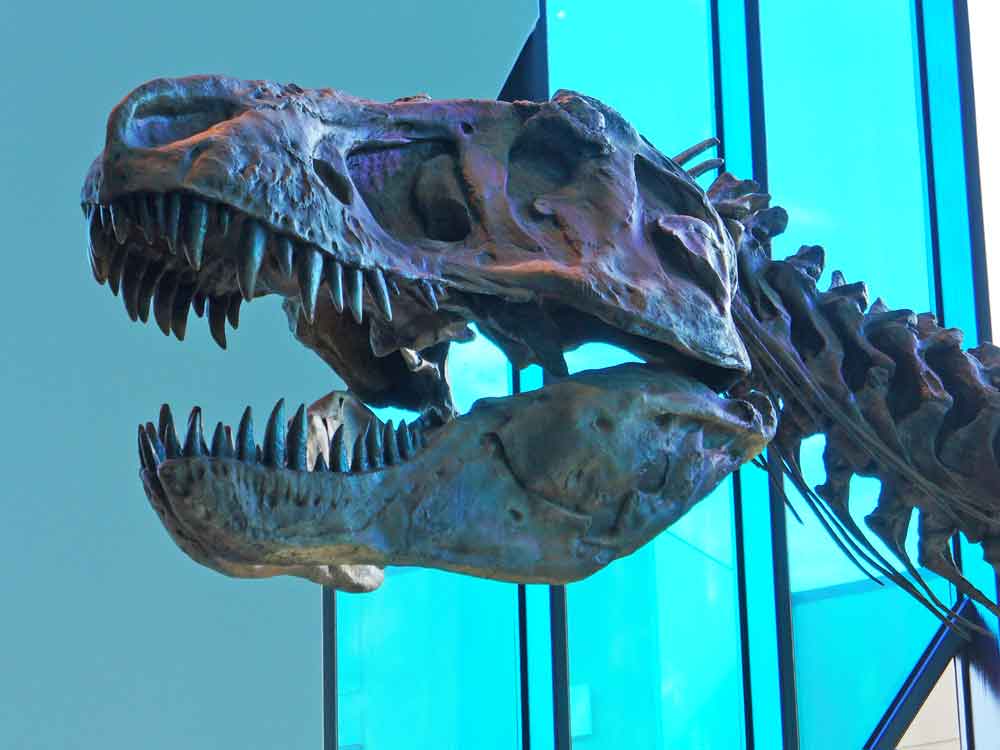
If you stand where I stood to take the pic of the whole exhibit of large images from Sable Island, and you rotate 180 degrees, you see the life-size skeleton of a T. rex.
I'd never noticed those wispy bones under the neck. I wonder what those are for!
This was the first time I'd been in a dino museum that was built since I took Dino 101. It was interesting to see info that was all up to date. (Older museums often have some up-to-date info, and some older info that does not reflect current best thinking about dinos.)
I remembered hearing in Dino 101 that young dinos often were different enough in form from mature adults that they had been thought to be of different species, but I do not remember that we heard this was true for T. rex. (As always, click on any image to see a larger version.)
The one thing I saw that contradicted what we were told in Dino 101 is about the adult T. rex arms. They are very short for the size of the critter (about the length of a human arm....), but they are very substantial. We were told that the marks that tendons leave on bone reflects the usage -- heavy-duty usage leaves bigger marks than light usage. Skeletal evidence is that T. rex arms saw serious heavy usage. We have no idea for what, but the scientists in Dino 101 told us those arms were used, hard, for something.
This is a nice little museum, and the parts we saw were all free of charge. Definitely worth a visit, if you are in the area!
.
Showing posts with label Dino 101: Dinosaur Paleobiology. Show all posts
Saturday, October 31, 2015
Wednesday, September 02, 2015
some of my favorite MOOCS start new sessions this week
.
I just became aware that some of my favorite online classes start new sessions this week!
The Brain and Space -- "This course is about how the brain creates our sense of spatial location from a variety of sensory and motor sources, and how this spatial sense in turn shapes our cognitive abilities."
Dino 101 -- "Dinosaur Paleobiology is a 12-lesson course teaching a comprehensive overview of non-avian dinosaurs. Topics covered: anatomy, eating, locomotion, growth, environmental and behavioral adaptations, origins and extinction. Lessons are delivered from museums, fossil-preparation labs and dig sites."
The Science of Happiness -- "The first MOOC to teach positive psychology. Learn science-based principles and practices for a happy, meaningful life."
I can heartily recommend any or all of these classes. All different, all interesting. So glad they are still available for anyone who might like to participate.
(And all for free -- sit in and listen to as many, or as few, lectures as you like. No risk, no obligation. :-) )
.
I just became aware that some of my favorite online classes start new sessions this week!
The Brain and Space -- "This course is about how the brain creates our sense of spatial location from a variety of sensory and motor sources, and how this spatial sense in turn shapes our cognitive abilities."
Dino 101 -- "Dinosaur Paleobiology is a 12-lesson course teaching a comprehensive overview of non-avian dinosaurs. Topics covered: anatomy, eating, locomotion, growth, environmental and behavioral adaptations, origins and extinction. Lessons are delivered from museums, fossil-preparation labs and dig sites."
The Science of Happiness -- "The first MOOC to teach positive psychology. Learn science-based principles and practices for a happy, meaningful life."
I can heartily recommend any or all of these classes. All different, all interesting. So glad they are still available for anyone who might like to participate.
(And all for free -- sit in and listen to as many, or as few, lectures as you like. No risk, no obligation. :-) )
.
Sunday, August 30, 2015
August 14 -- geology, mammals, dinos
.
Wandering on. Having a glance into an exhibit on First Peoples' lifestyles -- this is a way to take dried squash and make it much more transportable! It looks almost like it was knitted! Human ingenuity never ceases to amaze me.
Looking at some geological specimens. I believe all of these things are lava formations, and I'm sure it said the biggest one was a lava formation. I wonder what it squeezed through, to end looking like it was extruded.
Oh my. I don't remember seeing anything remotely like this before. They have sliced through an iron meteorite. Look at the pattern in there! (this was at least 2' from end to end)
It looks to me like the sample above is #18. The descriptive info says "Canyon Diablo, Iron (IA), found 1891 in Coconino Co., Arizona. Recovered weight, > 19,000 kg" Yowza -- more than 19,000 kg??? I wonder how big the whole thing was! And -- how did they go about "recovering" an object that weighed ">19,000 kg" back in 1891! After cutting it up, perhaps? I also want to know how old it is....
Close up. So cool..... I never would have suspected all of this was going on. I've seen iron meteorites in museums before, and as I recall them, they have been a sort of rusty brown, evenly, all over the outside........... No hint of all this silvery complexity inside!
Wandering on. Ordovician Trilobites, from 490-443 million years ago. These are Onnia superba, from Morocco.
I wonder why they are textured as they are. All that stippling in the front. And why those long things projecting backwards.
This is Cybele panderi, from St. Petersburg, Russia. Trilobites everywhere!
This is a Devonian Trilobite, from 417-354 million years ago. Kolihapeltis rabatensis, also from Morocco. Wonder why it needed those long things coming off its head and curving up and back toward its tail.....
Something a little closer to home -- a model of an early mammal. Alas, I failed to capture the info. I thought surely I could find it on the Field Museum's website, but ... no. Their website is surprisingly silent on the issue of objects on display. I mean -- I know that putting all of the data about their collections (or even the contents of current exhibitions) into a db would be an Ordeal, but still. Sheesh.
I googled up something like rat-like early mammal model, and found this one at the Smithsonian, of Morganucodon oelheri. Similar, for sure, to the one by my hand, but apparently much smaller. (I guess I don't know that the model in the Field Museum is life-size....)
As it says on the Smithsonian's site "Only 10 cm (4 in) long, its DNA was passed on to billions of descendants – including you." Easy to take in stride, when we know that we share genes with Earthly bacteria and plants!
Near the critter above, I read a sign that says that in addition to the other things we all know are unique to mammals, we are the only ones who use a diaphragm to breathe, and we are the only ones who have three bones in our middle ears.
I was gobsmacked when I learned in Dino 101 that dinos (LIKE BIRDS) breathed in a completely different way than we do. Who knew?!?!?
It was only when I read it in the Field Museum that I knew that three ear bones (evolved from extra jaw bones that reptiles have) are also unique to us furry critters who feed milk to our babies.
Speaking of dinos, the Field Museum has lots. This one was 6 or 8' long, I think.
I can't say I'm sorry that a close personal encounter with this one (and her/his buddies) is not possible for me...............
Did you know there were once snub-nosed crocodiles? Oh, wait, it's from Madagascar -- lots of unusual things have come from there..........
Of course there is a shop when you leave the dino area. They have some excellent plastic dinos. Scary, though -- when I was first buying plastic dinos, they were a few dollars. Now they are much cooler than they used to be (much, much more detail), and the nice ones are much more expensive. Like $35.
Did you know that you, too, can own a (cast of) a piece of Sue? How cool.
Not something I need to own, but isn't it cool that you, or I, could, if we wanted?!?!
Here are some parts of Sue that are right outside the dino shop.
Gastralia. Who knew. !!!
There's a model (1/3 size) of Sue's head, as you walk away from the dino shop toward the front of the museum. I want it to have better colors, and I really really want to see the feathers! My Dino 101 prof told us that there is clear and compelling evidence that species in the groups that include T. rex had at least some feathers...... !!!! Tantalizing, to be pretty darn sure they were there, but not know where, or what they looked like. (Perhaps "just" for display -- rising up in a crest over their head when they were aroused?)
I've said this is a big museum -- this is looking from near the front of the museum toward the back, through arches, arches, arches...........
See Sue's 1/3 size head, at left, where the guy is coming out of the dino shop? And under the other side of the arch are the cases with Sue's gastralia.
I didn't notice all the decoration on the ceiling until I saw the previous image on "the big screen".....
When we came into the museum, on the 14th, we got a head-on look at Sue, with her portrait above her head (on a second-floor wall). It turns out that the skull, downstairs with the rest of the skeleton, is a cast. The actual fossils of her skull are so heavy that they didn't want to have to think about how to support them in a realistic T. rex pose. So they are up here on the second floor, under the portrait.
Big. Really big. The people behind it are a bit deceiving, for scale. The case is pretty big, too,so those people are farther away than we might think. But Sue's teeth are not the same diameter as that woman's arms.......
This skull is between 3 and 4 feet from nose to back-of-head, I think. Yikes.
In yesterday's post I talked about mammals having three bones in their ears. I believe T. rex had but one.
We are standing very near the case with Sue's skull, looking into the big hall. You can see Sue, and a couple of elephants. The volunteers that had the horns and antlers for us to touch were near the elephants.
.
Wandering on. Having a glance into an exhibit on First Peoples' lifestyles -- this is a way to take dried squash and make it much more transportable! It looks almost like it was knitted! Human ingenuity never ceases to amaze me.
Looking at some geological specimens. I believe all of these things are lava formations, and I'm sure it said the biggest one was a lava formation. I wonder what it squeezed through, to end looking like it was extruded.
Oh my. I don't remember seeing anything remotely like this before. They have sliced through an iron meteorite. Look at the pattern in there! (this was at least 2' from end to end)
It looks to me like the sample above is #18. The descriptive info says "Canyon Diablo, Iron (IA), found 1891 in Coconino Co., Arizona. Recovered weight, > 19,000 kg" Yowza -- more than 19,000 kg??? I wonder how big the whole thing was! And -- how did they go about "recovering" an object that weighed ">19,000 kg" back in 1891! After cutting it up, perhaps? I also want to know how old it is....
Close up. So cool..... I never would have suspected all of this was going on. I've seen iron meteorites in museums before, and as I recall them, they have been a sort of rusty brown, evenly, all over the outside........... No hint of all this silvery complexity inside!
Wandering on. Ordovician Trilobites, from 490-443 million years ago. These are Onnia superba, from Morocco.
I wonder why they are textured as they are. All that stippling in the front. And why those long things projecting backwards.
This is Cybele panderi, from St. Petersburg, Russia. Trilobites everywhere!
This is a Devonian Trilobite, from 417-354 million years ago. Kolihapeltis rabatensis, also from Morocco. Wonder why it needed those long things coming off its head and curving up and back toward its tail.....
Something a little closer to home -- a model of an early mammal. Alas, I failed to capture the info. I thought surely I could find it on the Field Museum's website, but ... no. Their website is surprisingly silent on the issue of objects on display. I mean -- I know that putting all of the data about their collections (or even the contents of current exhibitions) into a db would be an Ordeal, but still. Sheesh.
I googled up something like rat-like early mammal model, and found this one at the Smithsonian, of Morganucodon oelheri. Similar, for sure, to the one by my hand, but apparently much smaller. (I guess I don't know that the model in the Field Museum is life-size....)
As it says on the Smithsonian's site "Only 10 cm (4 in) long, its DNA was passed on to billions of descendants – including you." Easy to take in stride, when we know that we share genes with Earthly bacteria and plants!
Near the critter above, I read a sign that says that in addition to the other things we all know are unique to mammals, we are the only ones who use a diaphragm to breathe, and we are the only ones who have three bones in our middle ears.
I was gobsmacked when I learned in Dino 101 that dinos (LIKE BIRDS) breathed in a completely different way than we do. Who knew?!?!?
It was only when I read it in the Field Museum that I knew that three ear bones (evolved from extra jaw bones that reptiles have) are also unique to us furry critters who feed milk to our babies.
Speaking of dinos, the Field Museum has lots. This one was 6 or 8' long, I think.
I can't say I'm sorry that a close personal encounter with this one (and her/his buddies) is not possible for me...............
Did you know there were once snub-nosed crocodiles? Oh, wait, it's from Madagascar -- lots of unusual things have come from there..........
Of course there is a shop when you leave the dino area. They have some excellent plastic dinos. Scary, though -- when I was first buying plastic dinos, they were a few dollars. Now they are much cooler than they used to be (much, much more detail), and the nice ones are much more expensive. Like $35.
Did you know that you, too, can own a (cast of) a piece of Sue? How cool.
Not something I need to own, but isn't it cool that you, or I, could, if we wanted?!?!
Here are some parts of Sue that are right outside the dino shop.
Gastralia. Who knew. !!!
There's a model (1/3 size) of Sue's head, as you walk away from the dino shop toward the front of the museum. I want it to have better colors, and I really really want to see the feathers! My Dino 101 prof told us that there is clear and compelling evidence that species in the groups that include T. rex had at least some feathers...... !!!! Tantalizing, to be pretty darn sure they were there, but not know where, or what they looked like. (Perhaps "just" for display -- rising up in a crest over their head when they were aroused?)
I've said this is a big museum -- this is looking from near the front of the museum toward the back, through arches, arches, arches...........
See Sue's 1/3 size head, at left, where the guy is coming out of the dino shop? And under the other side of the arch are the cases with Sue's gastralia.
I didn't notice all the decoration on the ceiling until I saw the previous image on "the big screen".....
When we came into the museum, on the 14th, we got a head-on look at Sue, with her portrait above her head (on a second-floor wall). It turns out that the skull, downstairs with the rest of the skeleton, is a cast. The actual fossils of her skull are so heavy that they didn't want to have to think about how to support them in a realistic T. rex pose. So they are up here on the second floor, under the portrait.
Big. Really big. The people behind it are a bit deceiving, for scale. The case is pretty big, too,so those people are farther away than we might think. But Sue's teeth are not the same diameter as that woman's arms.......
This skull is between 3 and 4 feet from nose to back-of-head, I think. Yikes.
In yesterday's post I talked about mammals having three bones in their ears. I believe T. rex had but one.
We are standing very near the case with Sue's skull, looking into the big hall. You can see Sue, and a couple of elephants. The volunteers that had the horns and antlers for us to touch were near the elephants.
.
Labels:
Chicago,
Dino 101: Dinosaur Paleobiology
Monday, June 08, 2015
new sort of dino found in Alberta
.
The fossilized skull of the new dino was discovered in Alberta.
My Dino 101 class was taught from the University of Alberta, and they took us on field trips to the Royal Tyrell Museum.
Not to mention that there's a quote in the article from a geologist at Indiana University, Purdue University at Fort Wayne, Indiana. My paternal grandparents helped get IUPU Fort Wayne rolling.
Cool illustration of this new relative of triceratops in the article, and a good pic of the skull.
.
The fossilized skull of the new dino was discovered in Alberta.
My Dino 101 class was taught from the University of Alberta, and they took us on field trips to the Royal Tyrell Museum.
Not to mention that there's a quote in the article from a geologist at Indiana University, Purdue University at Fort Wayne, Indiana. My paternal grandparents helped get IUPU Fort Wayne rolling.
Cool illustration of this new relative of triceratops in the article, and a good pic of the skull.
.
Wednesday, December 31, 2014
Friday, December 13, 2013
You, too, can take Dino 101, too!
.
You, too, can take Dino 101, too!
This is a very interesting and well-presented class. It has a slower pace than some classes I've taken, which makes it perfect for a busy person. If you are interested in dinos and/or paleontology, consider making yourself a present of Dino 101! (You can't beat the price -- free!)
.
You, too, can take Dino 101, too!
This is a very interesting and well-presented class. It has a slower pace than some classes I've taken, which makes it perfect for a busy person. If you are interested in dinos and/or paleontology, consider making yourself a present of Dino 101! (You can't beat the price -- free!)
.
Labels:
Dino 101: Dinosaur Paleobiology
Monday, December 02, 2013
What makes humans different from other sorts of organisms?
.
I've heard a lot, in Genes and the Human Condition, about what makes us the same as others, and what makes us different.
My very favorite graphic, so far, shows a section of DNA as it is found in chickens, in chimps, and in us. Mostly the same in all of us, but................
I didn't find a copyright-free version of the image to show you. If you click on this link, and scroll down, you will find a mostly-gray rectangular image in the middle (left/right-wise) that has pics of a man, a chimp, and a chicken. In a magenta band at the top of the image, it says "Scanning the Genome." The image shows the sequence of DNA, as it's found in chickens, chimps, and humans.
You may recall my reporting from Dino 101 that there is clear and compelling evidence that chickens (and the rest of the birds) are descended directly from dinosaurs. You may also recall my post about dimetrodon, which talks about how we know we are more closely related to dimetrodon than we and dimetrodon were related to dinosaurs.
The last common ancestor for chickens (and dinos!) and chimps (and us) was before dimetrodon. Before synapsids and diapsids went their separate ways. Long before the first dinos walked the Earth.
In Genes, the estimate for the last common ancestor for chickens and chimps (and us) was 300,000,000 years ago. Chimps and chickens show almost the same DNA sequence, even after 300,000,000 years of separate evolution. (Which is kind of amazing in itself, don't you think?) Dinos, from whom chickens have inherited this DNA, presumably had the same sequence we see in chickens today.
(Digression -- If I understand correctly what Ive been taught -- when a section of DNA is as similar as this between two organisms that haven't had a common ancestor in 300,000,000 years, we believe the DNA is unchanged over that amount of time. This indicates DNA that is essential to an organism -- most changes to this DNA are fatal. End of Digression.)
Katharine Pollard and her team look for the areas of the human genome that differ the most from the chimp genome. H(uman) A(ccelerated) R(egion) is the name Pollard et al have given to sections of DNA that are the most different between us and chimps. The HARs are numbered by the degree of difference.
The section of DNA in the graphic is HAR1. It is the section of our genome that shows the most difference from the corresponding section in the chimp genome. HAR1 is about brain development.
Notice that the difference in this sequence, between chimps and chickens after 300,000,000 years of separate evolution is only two changes.
Current thinking is that we and chimps had our last common ancestor 7-7.5 million years ago. In that relatively short span of time, our version of the HAR1 section of DNA has changed by 18 differences from the chimp version of this section of DNA.
(Digression -- Don't you think this was a smart way to look for the things that make us the most different from chimps? (Note also the illustrations that follow the one I'm talking about -- HAR2 is about development of wrists and thumbs........ End of digression.)
My very favorite thing about the graphic is that they chose a descendant of dinos to include. (For all I know, they could have included a turtle. Or a fruit fly..... But they picked a dino's child.............)
I am tickled to have that chicken (and her dino ancestry!) included in the info about genetic change over time.
I love it when what I learn in one place connects to and enriches what I learned somewhere else.........
.
I've heard a lot, in Genes and the Human Condition, about what makes us the same as others, and what makes us different.
My very favorite graphic, so far, shows a section of DNA as it is found in chickens, in chimps, and in us. Mostly the same in all of us, but................
I didn't find a copyright-free version of the image to show you. If you click on this link, and scroll down, you will find a mostly-gray rectangular image in the middle (left/right-wise) that has pics of a man, a chimp, and a chicken. In a magenta band at the top of the image, it says "Scanning the Genome." The image shows the sequence of DNA, as it's found in chickens, chimps, and humans.
You may recall my reporting from Dino 101 that there is clear and compelling evidence that chickens (and the rest of the birds) are descended directly from dinosaurs. You may also recall my post about dimetrodon, which talks about how we know we are more closely related to dimetrodon than we and dimetrodon were related to dinosaurs.
The last common ancestor for chickens (and dinos!) and chimps (and us) was before dimetrodon. Before synapsids and diapsids went their separate ways. Long before the first dinos walked the Earth.
In Genes, the estimate for the last common ancestor for chickens and chimps (and us) was 300,000,000 years ago. Chimps and chickens show almost the same DNA sequence, even after 300,000,000 years of separate evolution. (Which is kind of amazing in itself, don't you think?) Dinos, from whom chickens have inherited this DNA, presumably had the same sequence we see in chickens today.
(Digression -- If I understand correctly what Ive been taught -- when a section of DNA is as similar as this between two organisms that haven't had a common ancestor in 300,000,000 years, we believe the DNA is unchanged over that amount of time. This indicates DNA that is essential to an organism -- most changes to this DNA are fatal. End of Digression.)
Katharine Pollard and her team look for the areas of the human genome that differ the most from the chimp genome. H(uman) A(ccelerated) R(egion) is the name Pollard et al have given to sections of DNA that are the most different between us and chimps. The HARs are numbered by the degree of difference.
The section of DNA in the graphic is HAR1. It is the section of our genome that shows the most difference from the corresponding section in the chimp genome. HAR1 is about brain development.
Notice that the difference in this sequence, between chimps and chickens after 300,000,000 years of separate evolution is only two changes.
Current thinking is that we and chimps had our last common ancestor 7-7.5 million years ago. In that relatively short span of time, our version of the HAR1 section of DNA has changed by 18 differences from the chimp version of this section of DNA.
(Digression -- Don't you think this was a smart way to look for the things that make us the most different from chimps? (Note also the illustrations that follow the one I'm talking about -- HAR2 is about development of wrists and thumbs........ End of digression.)
My very favorite thing about the graphic is that they chose a descendant of dinos to include. (For all I know, they could have included a turtle. Or a fruit fly..... But they picked a dino's child.............)
I am tickled to have that chicken (and her dino ancestry!) included in the info about genetic change over time.
I love it when what I learn in one place connects to and enriches what I learned somewhere else.........
.
Tuesday, November 19, 2013
the end of Plants and Dinos
.
I took the final for What a Plant Knows on Monday. This is the first time I haven't gotten feedback on a Coursera test or quiz immediately after I took it. We won't get feedback on this exam until a week from today. I was sure I knew some of the answers right off, but others............ I don't know.
Today I listened to the last lectures in Dino 101: Dinosaur Paleobiology. Fittingly, we heard about the end of the dinos. I hadn't understood the extent of the catastrophe(s) caused by the Earth being hit by that meteor, about 65,000,000 years ago.......... I also hadn't realized that the meteor was the size of Mt. Everest. !!!!! No wonder it caused a whole set of horrendous catastrophes! I still have to take one last quiz, and then Dino class will be over.
I am sad that these two classes are over. I learned so many things that I'd never imagined..............
I'm signed up for Roman Architecture in January. A lot of people seem to stick with one subject area. Lots of people from Archaeology were in Dino class, and they mentioned taking other history classes (Human Evolution, say).
I am not aware of others bouncing around as I have -- Model Thinking, Think Again, Archaeology, Maps and the Geospatial Revolution, a History of Rock Music, Dinos, Plants............. (Along with a few other classes that I've looked at but have not done the work for!) I really enjoy being able to have a bit of this, a bit of that, and a bit of something else.............
I'm finding that it's the science classes that have really engrossed me. I wonder if that is a coincidence. Or not.................
.
I took the final for What a Plant Knows on Monday. This is the first time I haven't gotten feedback on a Coursera test or quiz immediately after I took it. We won't get feedback on this exam until a week from today. I was sure I knew some of the answers right off, but others............ I don't know.
Today I listened to the last lectures in Dino 101: Dinosaur Paleobiology. Fittingly, we heard about the end of the dinos. I hadn't understood the extent of the catastrophe(s) caused by the Earth being hit by that meteor, about 65,000,000 years ago.......... I also hadn't realized that the meteor was the size of Mt. Everest. !!!!! No wonder it caused a whole set of horrendous catastrophes! I still have to take one last quiz, and then Dino class will be over.
I am sad that these two classes are over. I learned so many things that I'd never imagined..............
I'm signed up for Roman Architecture in January. A lot of people seem to stick with one subject area. Lots of people from Archaeology were in Dino class, and they mentioned taking other history classes (Human Evolution, say).
I am not aware of others bouncing around as I have -- Model Thinking, Think Again, Archaeology, Maps and the Geospatial Revolution, a History of Rock Music, Dinos, Plants............. (Along with a few other classes that I've looked at but have not done the work for!) I really enjoy being able to have a bit of this, a bit of that, and a bit of something else.............
I'm finding that it's the science classes that have really engrossed me. I wonder if that is a coincidence. Or not.................
.
Friday, November 15, 2013
Dinofunny
.
Somehow, we never heard about these aspects of dino behavior in Dino 101!
I urge you to click through the "dino behavior" link above, if you could use a chuckle......
.
Somehow, we never heard about these aspects of dino behavior in Dino 101!
I urge you to click through the "dino behavior" link above, if you could use a chuckle......
.
Wednesday, November 13, 2013
Dimetrodon!
.
We visit a lot of science museums, and we have a lot of souvenirs hanging around.
Last night I was talking to my better half about the things I am learning in Dino 101 (and in What a Plant Knows -- another great class). I happened to notice this, standing on a shelf in the room, as it always does.
I really looked at it last night, and thought "Dimetrodon!" And so it is (it says so on its belly!).
I began to tell my husband how Dimetrodon was not a dino, but rather was from before dinos, and how Dimetrodon was more closely related to us than it was to dinos. I told him how the vertebrate family tree has branches depending on how many fenestrae are in the critters' skulls, and that our shared synapsid-idity is part of what we have in common with Dimetrodons but not with dinos........
I didn't know any of this, before this class, but I knew it all (and much more!), last night, and could eagerly share it.
Thank you, Dino 101 staff, for enriching my life. :-)
.
We visit a lot of science museums, and we have a lot of souvenirs hanging around.
Last night I was talking to my better half about the things I am learning in Dino 101 (and in What a Plant Knows -- another great class). I happened to notice this, standing on a shelf in the room, as it always does.
I really looked at it last night, and thought "Dimetrodon!" And so it is (it says so on its belly!).
I began to tell my husband how Dimetrodon was not a dino, but rather was from before dinos, and how Dimetrodon was more closely related to us than it was to dinos. I told him how the vertebrate family tree has branches depending on how many fenestrae are in the critters' skulls, and that our shared synapsid-idity is part of what we have in common with Dimetrodons but not with dinos........
I didn't know any of this, before this class, but I knew it all (and much more!), last night, and could eagerly share it.
Thank you, Dino 101 staff, for enriching my life. :-)
.
Labels:
Dino 101: Dinosaur Paleobiology
Tuesday, November 05, 2013
continental drift
.
This week in Dino 101 we are learning about plate tectonics.
Once upon a time, a long time ago, when I was in 7th grade, one of my classmates did a science project on continental drift. He presented it to our science class, so I have been familiar with this idea for about 50 years. (I just found my old friend by googling -- he's now working at MIT..........)
Continental drift is the theory that the outside crust of our planet moves around, over time. This idea was radical, in the early part of the 20th century, but after copious evidence for plate tectonics was gathered by deep-sea exploration in the 1950s and 1960s, it is accepted now.
Why are we learning about this in dino class? About 240 million years ago, nearly all of the land was mashed together in one giant continent (leaving the rest of the planet covered in one giant ocean........). This is about when dinos began to walk the Earth.
The fact that the same sorts of dino fossils are found in eastern Brasil and in western Africa is one of the reasons that people (especially Albert Wegener) first suspected the existence of continental drift.........
The Age of Dinos lasted until the mass (global) extinction about 66 million years ago.
(It may not be clear at first -- blue is ocean and tan is land in this video.)
.
This week in Dino 101 we are learning about plate tectonics.
Once upon a time, a long time ago, when I was in 7th grade, one of my classmates did a science project on continental drift. He presented it to our science class, so I have been familiar with this idea for about 50 years. (I just found my old friend by googling -- he's now working at MIT..........)
Continental drift is the theory that the outside crust of our planet moves around, over time. This idea was radical, in the early part of the 20th century, but after copious evidence for plate tectonics was gathered by deep-sea exploration in the 1950s and 1960s, it is accepted now.
Why are we learning about this in dino class? About 240 million years ago, nearly all of the land was mashed together in one giant continent (leaving the rest of the planet covered in one giant ocean........). This is about when dinos began to walk the Earth.
The fact that the same sorts of dino fossils are found in eastern Brasil and in western Africa is one of the reasons that people (especially Albert Wegener) first suspected the existence of continental drift.........
The Age of Dinos lasted until the mass (global) extinction about 66 million years ago.
(It may not be clear at first -- blue is ocean and tan is land in this video.)
.
Friday, November 01, 2013
UPDATED 11/2/13 -- This week in Dino class.....
...they are talking about stratigraphy and the
principal of superposition (older stuff on the bottom, newer stuff on
top, generally speaking). We learned about both of those concepts in archaeology (not a surprise), but while ideas are the same, the reality in the two concepts is quite different. The
entire archaeological record is in the last 200,000 years. The dinos
all lived more than 60 million years ago, and what can happen to the
rocks (let alone the continents and their positions!) in that amount of
time makes the stratigraphy much more ... interesting.
Fossils are found in sedimentary rock. Layers of sediment are laid down (in river channels, perhaps), and, over (LOTS OF) time, they become rock. Later still, a volcano may erupt up through the layers, or the layers may be near new mountain ranges which tip the older formations (or "crunch and fold" them). Tipped, crunched, and folded formations may have their top surfaces eroded away, and new layers may be laid on top.................
(At least the geography has stayed put [relatively speaking], in the archaeological context!)
Given that fossilization only takes place in wet environments (things have to be buried rather quickly if they are going to fossilize), which doesn't happen in desserts at all, and doesn't happen in forests or prairies, either, really, and given that carcases are scavenged, and/or tumbled along with the current in a river bed before they ever might be fossilized, and given that we don't find fossils until they are exposed on the surface of the earth, generally speaking, and that they will erode away to nothing once exposed.....
Throw in all of that geological manipulation of the rocky structure of the surface of the planet over the millions of years..........
Given all that, it's amazing that we know anything about dinos at all, I think.
And yet we do, and we're learning more all the time. Cool...............
Dino class is being taught from the University of Alberta. I've thought about taking the trans-Canada train. Yesterday I wondered how close the trans-Canada train goes to Dinosaur Provincial Park in Alberta, and I spent some time looking at maps. (The answer is -- Edmonton, where U of Alberta is, is on the trans-Canada route, and Dino Park is about 4 hours from Edmonton by car.)
I bet Coursera didn't think about enhanced tourism as one of the benefits of their offerings, but I bet it is happening...........
UPDATE, 11/2/13 -- Victoria, who left a comment here (how cool is that???), is one of our teachers in Dino 101! Her blog is here, with lots of info about paleontological doings in Edmonton and surrounds. Thanks for the visit here, Victoria, and for commenting. I would LOVE to visit the lab!!! :-)
ps, Victoria -- if I make any mistakes in anything I say about Dino class here, I hope you will correct me!
.
Fossils are found in sedimentary rock. Layers of sediment are laid down (in river channels, perhaps), and, over (LOTS OF) time, they become rock. Later still, a volcano may erupt up through the layers, or the layers may be near new mountain ranges which tip the older formations (or "crunch and fold" them). Tipped, crunched, and folded formations may have their top surfaces eroded away, and new layers may be laid on top.................
(At least the geography has stayed put [relatively speaking], in the archaeological context!)
Given that fossilization only takes place in wet environments (things have to be buried rather quickly if they are going to fossilize), which doesn't happen in desserts at all, and doesn't happen in forests or prairies, either, really, and given that carcases are scavenged, and/or tumbled along with the current in a river bed before they ever might be fossilized, and given that we don't find fossils until they are exposed on the surface of the earth, generally speaking, and that they will erode away to nothing once exposed.....
Throw in all of that geological manipulation of the rocky structure of the surface of the planet over the millions of years..........
Given all that, it's amazing that we know anything about dinos at all, I think.
And yet we do, and we're learning more all the time. Cool...............
Dino class is being taught from the University of Alberta. I've thought about taking the trans-Canada train. Yesterday I wondered how close the trans-Canada train goes to Dinosaur Provincial Park in Alberta, and I spent some time looking at maps. (The answer is -- Edmonton, where U of Alberta is, is on the trans-Canada route, and Dino Park is about 4 hours from Edmonton by car.)
I bet Coursera didn't think about enhanced tourism as one of the benefits of their offerings, but I bet it is happening...........
UPDATE, 11/2/13 -- Victoria, who left a comment here (how cool is that???), is one of our teachers in Dino 101! Her blog is here, with lots of info about paleontological doings in Edmonton and surrounds. Thanks for the visit here, Victoria, and for commenting. I would LOVE to visit the lab!!! :-)
ps, Victoria -- if I make any mistakes in anything I say about Dino class here, I hope you will correct me!
.
Tuesday, October 22, 2013
October 12 -- dino excellence
.
Now here's something I'd never done before. The Ann Arbor District Library is wandering afield from print publications. They have all sorts of musical performance tools, for example. I don't know what, exactly, but I've seen the cases waiting to be checked out.
They also have dino kits!
I was surprised to be offered this enormous bag when it was my turn to have kit "Tyrannosaurus rex 1"! It's not heavy, but it's bulky, and comes as a wheely bag.
Here's what we see when we open the bag -- a book, and some other interesting things, carefully protected in labeled, padded pockets.
Small foot claw. !!!
??
!!!
A really high-quality plastic model. Look at the detail! (I think the arms shown are way too big, though, remembering the T. rex arm bones we saw in Dino 101......)
In the next pocket is a cast of a T. rex brain. (In some cases a fossilized skull leaves a space where the brain would have been, so they know what size and shape the brain would have been.)
Look at my hand, above and below................... Think about the size of the tooth, relative to the size of the brain............... (Dinos grew new teeth, and shed old teeth, throughout their lifetimes, pretty much like sharks do now. MANY dino teeth are found without roots -- which shows they were shed rather than part of an animal at the time it died. The root here means that the tooth from which this cast was made was part of the T. rex when it died.)
This cast is detailed enough that I could feel the serrations on the cutting edge of the tooth........ !!!
Last but not least, here is that "small claw."
Tooth and brain, on the rug (sorry about the distracting shadows....).
Tooth, brain, beagle(ish sort of guy). He says we are usurping his sunshine with our silly plastic stuff.
The book in the T. rex 1 kit was this one -- a real feast for the eyes. I didn't read it (I only had the kit for a week, and it was a busy week), but I enjoyed the pics. The pic on the cover of the book (you'll see it if you click through) shows what I expect are much more realistically-sized T. rex arms than those on the model in this kit.............. Really, really teeny arms, compared to the size of the critter..............
The kit also contained a DVD, which talked about how young dinos may have looked enough different from their parents that we have mistaken them for different species. It speculated that we may have mistaken youngsters and adults for different species often enough to account for about a third of what we now think are "known species." Interesting.
It was only when I was packing the goodies back into the bag that I noticed the model's mouth opens! Alas, I apparently failed to set the camera back to micro focus, so this is blurry.
But we can get the idea!
The library has several more dino kits -- I'm going to be checking all of them out!
How cool, to get to hold "teeth" and "brains" and examine them "up close and personal"!!!!
The evening of 12th we tried a new-to-us restaurant. We hadn't realized it would be full of tvs, blaring sports, and little kids. Not qualities of places where they concentrate on the food....
It was edible.
The sky was excellent..............
.
Now here's something I'd never done before. The Ann Arbor District Library is wandering afield from print publications. They have all sorts of musical performance tools, for example. I don't know what, exactly, but I've seen the cases waiting to be checked out.
They also have dino kits!
I was surprised to be offered this enormous bag when it was my turn to have kit "Tyrannosaurus rex 1"! It's not heavy, but it's bulky, and comes as a wheely bag.
Here's what we see when we open the bag -- a book, and some other interesting things, carefully protected in labeled, padded pockets.
Small foot claw. !!!
??
!!!
A really high-quality plastic model. Look at the detail! (I think the arms shown are way too big, though, remembering the T. rex arm bones we saw in Dino 101......)
In the next pocket is a cast of a T. rex brain. (In some cases a fossilized skull leaves a space where the brain would have been, so they know what size and shape the brain would have been.)
Look at my hand, above and below................... Think about the size of the tooth, relative to the size of the brain............... (Dinos grew new teeth, and shed old teeth, throughout their lifetimes, pretty much like sharks do now. MANY dino teeth are found without roots -- which shows they were shed rather than part of an animal at the time it died. The root here means that the tooth from which this cast was made was part of the T. rex when it died.)
This cast is detailed enough that I could feel the serrations on the cutting edge of the tooth........ !!!
Last but not least, here is that "small claw."
Tooth and brain, on the rug (sorry about the distracting shadows....).
Tooth, brain, beagle(ish sort of guy). He says we are usurping his sunshine with our silly plastic stuff.
The book in the T. rex 1 kit was this one -- a real feast for the eyes. I didn't read it (I only had the kit for a week, and it was a busy week), but I enjoyed the pics. The pic on the cover of the book (you'll see it if you click through) shows what I expect are much more realistically-sized T. rex arms than those on the model in this kit.............. Really, really teeny arms, compared to the size of the critter..............
The kit also contained a DVD, which talked about how young dinos may have looked enough different from their parents that we have mistaken them for different species. It speculated that we may have mistaken youngsters and adults for different species often enough to account for about a third of what we now think are "known species." Interesting.
It was only when I was packing the goodies back into the bag that I noticed the model's mouth opens! Alas, I apparently failed to set the camera back to micro focus, so this is blurry.
But we can get the idea!
The library has several more dino kits -- I'm going to be checking all of them out!
How cool, to get to hold "teeth" and "brains" and examine them "up close and personal"!!!!
The evening of 12th we tried a new-to-us restaurant. We hadn't realized it would be full of tvs, blaring sports, and little kids. Not qualities of places where they concentrate on the food....
It was edible.
The sky was excellent..............
.
Labels:
big sky,
books,
Dino 101: Dinosaur Paleobiology,
dog,
interesting links
Subscribe to:
Posts (Atom)