.
Warmer and drier than March 11.
I think these are the same redbud flowers we looked at on the 11th.
Ceiling in Union Station.
There was an exhibit on Pompeii at Union Station. Sections of mosaics. These tiles are no more than 1/2" square, if I remember correctly.
If I remember correctly, this deer was nearly 18" tall. I think
this is the biggest metal decorative object from ancient times that I
have ever seen. And it's in the best condition of any non-gold ancient
metal object I've ever seen.
Ceramic cups. These are the size of coffee mugs you might have in your cupboard, but they never held coffee.....
Looking at the different textures.
Here's something else I'd never seen before -- a sieve. Also -- note part of a frying pan at left. I'd never seen an ancient frying pan, either. One of the other visitors to the exhibit was speculating as to whether the types of metal available to the Romans would have made a decent frying pan. This is something that wouldn't have occurred to me, and I wonder what the answer is......
Closeup of sieve -- decorative hole patterns.
There were several pieces of gold jewelry. Bracelet, with earrings in back.
Woven (knitted?) gold necklace, and I believe those are earrings at bottom right.
Closeup of the necklace. CB, do you think this is the same technique by which your necklace was made?
I think the tallest of these glass jugs was about 8".
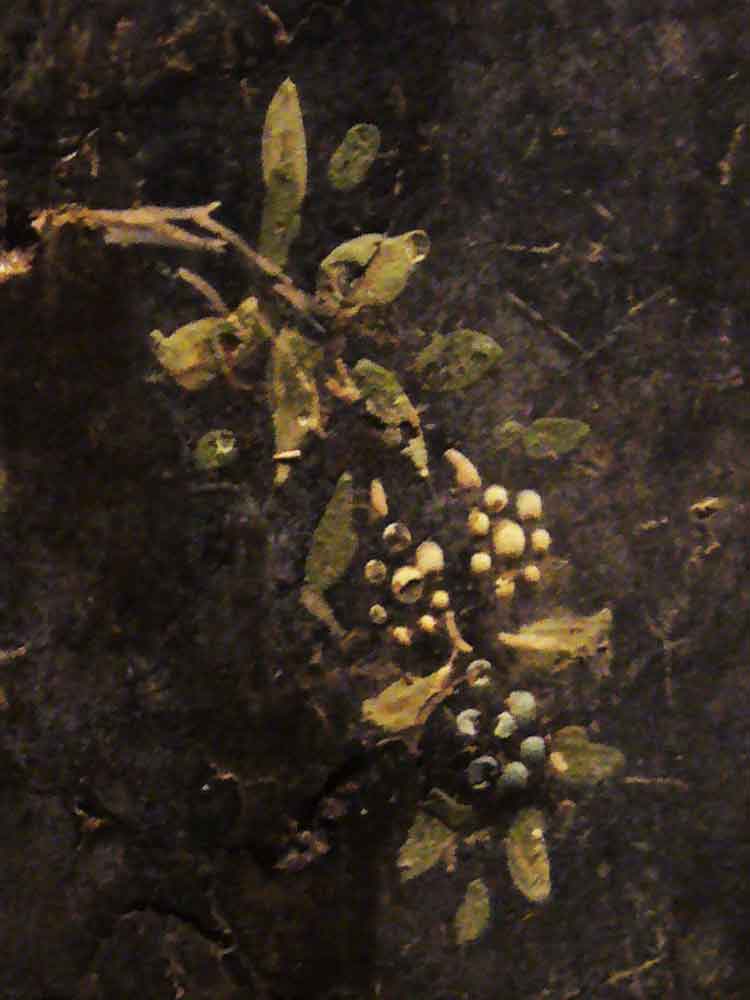
Pompeii was a place where many of the rich (really rich) and famous had vacation homes. Their houses were elaborately decorated and furnished. Their walls were painted.
Closer crop of the upper right corner of the above.
Greek statues were very idealized. Intended to represent an ideal, rather than an actual person. Roman statues were more likely to reflect a real person's looks and demeanor. Not that they know who this one is..........
I always like to see things I've never seen before. I was boggled by the deer, and interested by the sieves and the frying pan which can just be seen at the left of the first sieve pic.
Some of the things we were told in the identifying info did not agree with what I heard in the MOOC I took on Roman architecture. It seemed to me this exhibit implied that there were kitchens in most houses, when, in fact, kitchens were rare. I was told in the class that people probably ate out (or got take-out), rather than cooking at home. I have seen photos of the remains of multiple restaurants. The food was ready, and people would walk in and get a bowl of soup or a plate of cooked food. We were told in class that there were few kitchens in houses, and fewer bathrooms. The Romans went to public baths. In part, no doubt, because the public baths were very social. You'd meet your friends, and spend time together at the baths.....
I am glad to have seen the exhibit.
.
Showing posts with label Roman Architecture. Show all posts
Tuesday, March 28, 2017
Thursday, May 12, 2016
May 6 -- Pompeii exhibit
.
The University of Michigan has a beautiful set of campuses. Here is a look at Angell Hall, with spring grass and flowering trees.
Graduations were happening, on the 6th. Each different school has its own graduation -- from the enormous School of Literature, Science, and the Arts, with thousands of graduates each spring, to the much smaller Law School, Medical School, School of Kinesiology......
Some of the smaller graduations took place on the 6th, I believe. I saw graduates in gowns, and lots of dressed-up family members.
Another happening in early May was a special exhibit in the Kelsey Museum of Archaeology about ancient Rome. On display were lots of artifacts from two structures in two cities (Pompeii and Oplontos) destroyed by volcanic eruptions in the first century of the Common Era.
One structure was an incredibly huge and elaborate private villa, which may have belonged to Poppaea, one of Nero's wives. The info said they have worked on excavating about 100 rooms -- less than half of the total number of rooms. That's a 60-meter swimming pool, at left......
A contemporary painting of the formal entrance to the villa.
I got to the museum after 3:00, only to learn that they close at 4:00. Unfortunate. So I was not able to poke around as much as I would have liked.
I thought it would have been helpful if the model had been labeled so we could tell which rooms we could see fragments of. Perhaps there was some of that sort of labeling, but I missed it, if there was.
I think this section of the model, below, shows the facade in the painting above (though the garden in front looks different......).
The exhibit included several iPads, each of which had a 3D image of what they believe some part of the villa looked like. You could have a 360-degree view from one point in a room, moving your finger across the tablet to rotate your view of the space.
This one is looking from one of the villa's rooms out at the swimming pool.
This is a tighter crop of the above. There were some fragments of statues in the exhibit. Some of those statues used to stand beside the pool. Here we can see statues and trees beside the pool.
The exhibit included many fragments of walls, showing something of the decoration. The big chunks are composed of smaller actual ancient bits, and the drawing on the wall indicates what they think the decoration looked like, back in the day.
A closer look.
Closer. In the previous one and the next one, you can see the individual fragments of the ancient wall, held in place by modern material.
Some lonesome fragments.
Lots of detail in these paintings -- shadows, highlights.....
When I took Roman Architecture, we learned that a lot of what is now thought to be true about Roman architecture has been gleaned from painting that embellished the insides of buildings. This is especially true of structures that would have been built of wood.
Paintings of buildings inform conclusions about structures which do not survive, and also give information about painted decoration of building exteriors.
Here's another tablet screen. This one shows a small courtyard. Note decorative painted striping on the pillar.
I'm always surprised when fragile objects have survived. Love the shape of this pitcher. If I recall correctly, it was about 10" tall.
Square-sided glass jug. I think it was about 8" tall.
Fragments of walls from a small room. Note tablet in lower left.
Here's a closer look at what we could see on the tablet screen. The texture of the wall in a bigger room, an opening into a smaller room..... Note the light place at right -- it's a small bit of window, looking out at the swimming pool.
Aphrodite. The striping behind her is similar to what was on the walls inside the villa from the painted pillar we saw on one of the tablets.
A small fragment of a mosaic floor. These tiles were about half an inch square.
Cute little bottle. I bet this feels good in your hand. It was about 4" tall, I think.
More glass. I bet the tallest of these objects was a bit over a foot tall.
I mentioned that two structures were represented in the exhibit. One was an incredibly luxurious villa. The other is thought to be something to do with the wine trade. Several individuals perished in this structure. Some of them wore gold jewelry and carried gold coins. Some may have been slaves.
Some very sumptuous objects were found in this building, in addition to wine amphorae, and a grain mill.
If we stop to think about what we believe to be true about the past, SO much depends on what we have happened to find. I expect our view of things is almost certainly skewed by what we have managed to discover.
There have to have been much that either did not survive, or has not yet been seen by modern eyes.
"The way it is" right now is hard enough to draw conclusions about. Looking at fragments of the past must necessarily give a very limited view of only part of what was reality.
.
The University of Michigan has a beautiful set of campuses. Here is a look at Angell Hall, with spring grass and flowering trees.
Graduations were happening, on the 6th. Each different school has its own graduation -- from the enormous School of Literature, Science, and the Arts, with thousands of graduates each spring, to the much smaller Law School, Medical School, School of Kinesiology......
Some of the smaller graduations took place on the 6th, I believe. I saw graduates in gowns, and lots of dressed-up family members.
Another happening in early May was a special exhibit in the Kelsey Museum of Archaeology about ancient Rome. On display were lots of artifacts from two structures in two cities (Pompeii and Oplontos) destroyed by volcanic eruptions in the first century of the Common Era.
One structure was an incredibly huge and elaborate private villa, which may have belonged to Poppaea, one of Nero's wives. The info said they have worked on excavating about 100 rooms -- less than half of the total number of rooms. That's a 60-meter swimming pool, at left......
A contemporary painting of the formal entrance to the villa.
I got to the museum after 3:00, only to learn that they close at 4:00. Unfortunate. So I was not able to poke around as much as I would have liked.
I thought it would have been helpful if the model had been labeled so we could tell which rooms we could see fragments of. Perhaps there was some of that sort of labeling, but I missed it, if there was.
I think this section of the model, below, shows the facade in the painting above (though the garden in front looks different......).
The exhibit included several iPads, each of which had a 3D image of what they believe some part of the villa looked like. You could have a 360-degree view from one point in a room, moving your finger across the tablet to rotate your view of the space.
This one is looking from one of the villa's rooms out at the swimming pool.
This is a tighter crop of the above. There were some fragments of statues in the exhibit. Some of those statues used to stand beside the pool. Here we can see statues and trees beside the pool.
The exhibit included many fragments of walls, showing something of the decoration. The big chunks are composed of smaller actual ancient bits, and the drawing on the wall indicates what they think the decoration looked like, back in the day.
A closer look.
Closer. In the previous one and the next one, you can see the individual fragments of the ancient wall, held in place by modern material.
Some lonesome fragments.
Lots of detail in these paintings -- shadows, highlights.....
When I took Roman Architecture, we learned that a lot of what is now thought to be true about Roman architecture has been gleaned from painting that embellished the insides of buildings. This is especially true of structures that would have been built of wood.
Paintings of buildings inform conclusions about structures which do not survive, and also give information about painted decoration of building exteriors.
Here's another tablet screen. This one shows a small courtyard. Note decorative painted striping on the pillar.
I'm always surprised when fragile objects have survived. Love the shape of this pitcher. If I recall correctly, it was about 10" tall.
Square-sided glass jug. I think it was about 8" tall.
Fragments of walls from a small room. Note tablet in lower left.
Here's a closer look at what we could see on the tablet screen. The texture of the wall in a bigger room, an opening into a smaller room..... Note the light place at right -- it's a small bit of window, looking out at the swimming pool.
Aphrodite. The striping behind her is similar to what was on the walls inside the villa from the painted pillar we saw on one of the tablets.
A small fragment of a mosaic floor. These tiles were about half an inch square.
Cute little bottle. I bet this feels good in your hand. It was about 4" tall, I think.
More glass. I bet the tallest of these objects was a bit over a foot tall.
I mentioned that two structures were represented in the exhibit. One was an incredibly luxurious villa. The other is thought to be something to do with the wine trade. Several individuals perished in this structure. Some of them wore gold jewelry and carried gold coins. Some may have been slaves.
Some very sumptuous objects were found in this building, in addition to wine amphorae, and a grain mill.
If we stop to think about what we believe to be true about the past, SO much depends on what we have happened to find. I expect our view of things is almost certainly skewed by what we have managed to discover.
There have to have been much that either did not survive, or has not yet been seen by modern eyes.
"The way it is" right now is hard enough to draw conclusions about. Looking at fragments of the past must necessarily give a very limited view of only part of what was reality.
.
Sunday, February 07, 2016
Lego models of ancient structures..........
.
There exist Lego models of ancient structures, intended to correctly imitate what was once reality.
Having taken Roman Architecture, I'd be interested in seeing the Colosseum and Pompeii, up close and personal............
(If you click through the Lego link above, have a look at the BINS of Lego blocks behind the artist responsible for the models.........)
.
There exist Lego models of ancient structures, intended to correctly imitate what was once reality.
Having taken Roman Architecture, I'd be interested in seeing the Colosseum and Pompeii, up close and personal............
(If you click through the Lego link above, have a look at the BINS of Lego blocks behind the artist responsible for the models.........)
.
Labels:
interesting links,
Roman Architecture
Thursday, July 10, 2014
June 22
.
Grass, violets, and shadows.
Daylilies. When I show you flowers, essentially none of them are mine. These are mine. Transplanted to Michigan from rural Indiana (near where my mom grew up).
Once planted in a reasonable amount of sunshine, they will grow and bloom for decades. (I planted them in front of my old house in 1980, and they are still going strong....)
I brought them with me to this house in 1985, and they are going strong here, too.
I've had less success with peonies. This is someone else's peony.
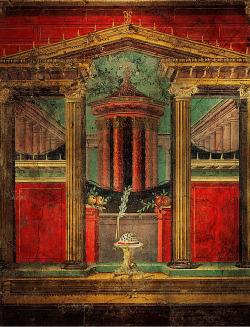
Remember I talked about broken pediments, with something round and pointy seen through the break in the pediment? Here's another house in my neighborhood with same. Isn't it interesting that a motif that was popular with the Romans, nearly 2000 years ago, is still seen on houses (and other buildings) today? (I wouldn't know this, if I hadn't taken Roman Architecture.....
Hostas.
.
Grass, violets, and shadows.
Daylilies. When I show you flowers, essentially none of them are mine. These are mine. Transplanted to Michigan from rural Indiana (near where my mom grew up).
Once planted in a reasonable amount of sunshine, they will grow and bloom for decades. (I planted them in front of my old house in 1980, and they are still going strong....)
I brought them with me to this house in 1985, and they are going strong here, too.
I've had less success with peonies. This is someone else's peony.
Remember I talked about broken pediments, with something round and pointy seen through the break in the pediment? Here's another house in my neighborhood with same. Isn't it interesting that a motif that was popular with the Romans, nearly 2000 years ago, is still seen on houses (and other buildings) today? (I wouldn't know this, if I hadn't taken Roman Architecture.....
Hostas.
.
Friday, May 23, 2014
May 11, continued
.
Magnolia
Isn't this pretty? So many different flowering trees, the chartreuse new growth, the dark evergreen, and the gray and blue houses?
When my daughter was little, there was a big wooden play structure in this park, with a big spiral slide from the top of the structure. My kid could climb all the way to the top of that structure before she could walk. She wore overalls, and I climbed right up behind her, holding the overall straps. She never fell, but if she had, I'd have had her. Taking care that she was ok -- MY job.
But in our litigious society, that structure was A Menace and has since come down. I wonder how my kid would have liked the much tamer (and, I daresay, more boring) structure that currently is found in this park................ I'm glad we had the cool structure, while she was the right age to want it.
Park, with dandelions and flowering trees.
Dandelions in the park. I wonder what that little pillar-thing is, at left, below. I wonder if it's some sort of property demarkation marker?
Note how the trees are growing from below the level of the park. This end of this park is up high, and is playground and stuff. The end of the grassy area, straight ahead, is the top of a hill. You can walk down into the ravine, and there's about as much ravine as there is of flat land, I think. That end of the park is mostly "unimproved woods," but there is a wood-chip path through it (we walked through there not too long ago), and there's a staircase at the other end, up from the bottom of the ravine to the sidewalk.
Quince!
See the big bumblebee, bottom (so to speak) left?
Love this color.......................
In Roman Architecture, the huge impact that Roman architecture has had on architecture in the ensuing millenia was a recurring theme.
I've walked past this a lot of times, but only noticed the week of the 11th that the elements here show a lot of Roman influence, especially at the top. That triangular pediment at the top, open to show (showcase!?!) something round and pointy........... Here is an example she talked about in class -- the pediment broken to showcase a shrine (which is round, with a pointy top) in the background.
There are lots of fairy doors in Ann Arbor, including a few in our neighborhood. This door has a front patio, with a wind turbine(?).
I think these are baby locust leaves.
Crab apple..........................
.
Magnolia
Isn't this pretty? So many different flowering trees, the chartreuse new growth, the dark evergreen, and the gray and blue houses?
When my daughter was little, there was a big wooden play structure in this park, with a big spiral slide from the top of the structure. My kid could climb all the way to the top of that structure before she could walk. She wore overalls, and I climbed right up behind her, holding the overall straps. She never fell, but if she had, I'd have had her. Taking care that she was ok -- MY job.
But in our litigious society, that structure was A Menace and has since come down. I wonder how my kid would have liked the much tamer (and, I daresay, more boring) structure that currently is found in this park................ I'm glad we had the cool structure, while she was the right age to want it.
Park, with dandelions and flowering trees.
Dandelions in the park. I wonder what that little pillar-thing is, at left, below. I wonder if it's some sort of property demarkation marker?
Note how the trees are growing from below the level of the park. This end of this park is up high, and is playground and stuff. The end of the grassy area, straight ahead, is the top of a hill. You can walk down into the ravine, and there's about as much ravine as there is of flat land, I think. That end of the park is mostly "unimproved woods," but there is a wood-chip path through it (we walked through there not too long ago), and there's a staircase at the other end, up from the bottom of the ravine to the sidewalk.
Quince!
See the big bumblebee, bottom (so to speak) left?
Love this color.......................
In Roman Architecture, the huge impact that Roman architecture has had on architecture in the ensuing millenia was a recurring theme.
I've walked past this a lot of times, but only noticed the week of the 11th that the elements here show a lot of Roman influence, especially at the top. That triangular pediment at the top, open to show (showcase!?!) something round and pointy........... Here is an example she talked about in class -- the pediment broken to showcase a shrine (which is round, with a pointy top) in the background.
There are lots of fairy doors in Ann Arbor, including a few in our neighborhood. This door has a front patio, with a wind turbine(?).
I think these are baby locust leaves.
Crab apple..........................
.
Labels:
Ann Arbor,
flowers,
Roman Architecture
Subscribe to:
Posts (Atom)